


















- Stock: In Stock
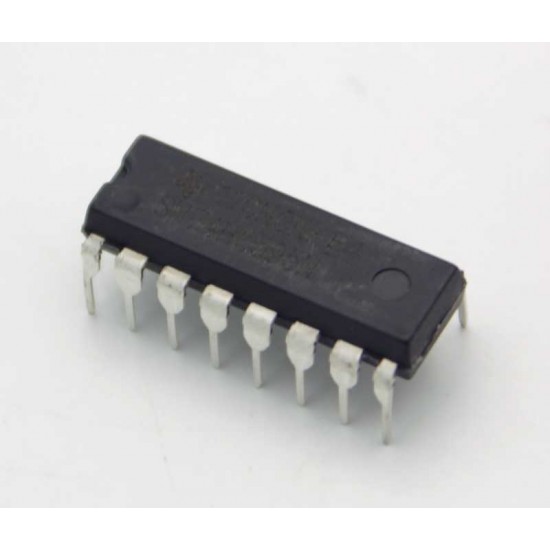
- Model: SN74HC148
- Weight: 1.05g
- Dimensions: 19.25mm x 8.80mm x 4.57mm
- SKU: 1069
Product Overview
The Texas Instruments SN74HC148 is a high-speed CMOS 8-to-3 line priority encoder designed for advanced digital logic architectures and embedded processing environments. Utilizing advanced silicon-gate CMOS technology, this integrated circuit achieves high-speed propagation times comparable to low-power Schottky TTL (LSTTL) devices while retaining the minimal power dissipation and high noise immunity inherently characteristic of standard CMOS circuitry. The device decodes data from eight active-low input lines (0 through 7) and provides a three-bit active-low binary (BCD) output corresponding to the highest-order active input, making it an indispensable building block for signal prioritization and resource arbitrating systems.
Technical Architecture and Logic Operation
Operating efficiently across a versatile supply voltage (VCC) range of 2V to 6V, the SN74HC148 provides robust signal conditioning and noise performance in both 3.3V and 5V digital systems. With a typical propagation delay time of just 16 ns at 5V operation, the IC facilitates rapid response times in demanding digital pipelines and real-time state machines. The architecture incorporates specialized cascading logic control signals, including an active-low Enable Input (EI), Enable Output (EO), and Group Select (GS) flags. These signals allow design engineers to cascade multiple SN74HC148 units seamlessly to construct n-bit priority encoders (such as 16-to-4 or 32-to-5 encoding arrays) without requiring external glue logic gates.
Electrical Characteristics and Signal Cascading
The SN74HC148 features low input current consumption of max 1 uA and balanced CMOS push-pull outputs capable of driving up to 10 LSTTL loads (4 mA sink and source at 5V). The active-low input lines ensure that the highest-priority data line (input 7 being highest, input 0 lowest) automatically overrides lower-order inputs. When the Enable Input (EI) is high, all outputs remain in a high state regardless of input conditions. When EI is low, the Group Select (GS) output goes low if any input line is active, signaling valid input presence, while the Enable Output (EO) goes low only when all input lines are inactive, seamlessly enabling the next lower-order encoder stage in cascaded arrays.
Applications and System Integration
Housed in a standard 16-pin plastic dual-in-line package (PDIP), the SN74HC148N is ideally suited for through-hole PCB assembly, prototyping breadboards, and ruggedized industrial hardware panels. Common system integration scenarios include hardware interrupt request prioritization in microprocessor units (MPUs) and microcontrollers, rotary switch and matrix keypad interface decoding, multi-channel fault monitoring, and priority data routing. Rated for an industrial operating temperature range of -40 degrees Celsius to +85 degrees Celsius, the device provides reliable, long-term operational stability in harsh thermal environments.