Menu
Your Cart
NOTICE: We have Fully discontinued physical walk-in customer service, RFQ, and LPO processing. Nerokas is now a FULLY DIGITAL ONLINE STORE, and our virtual assistant, Ginō AI, is here to help you navigate and checkout. Just ADD your Items to cart and type CHECKOUT on Ginō. Please note that corporate customers must register a corporate account to ensure proper Digital eTIMS/VAT processing.

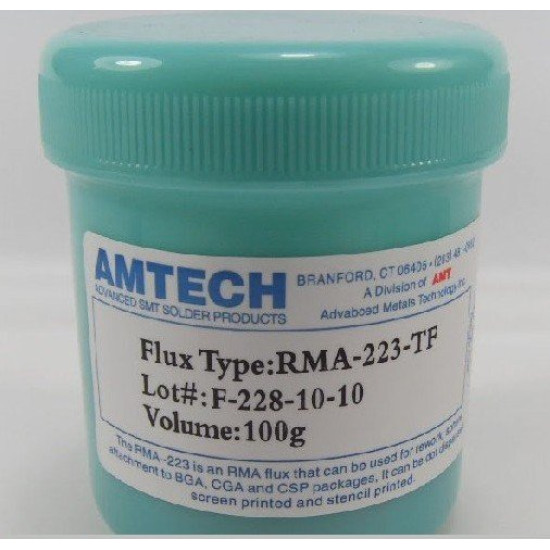
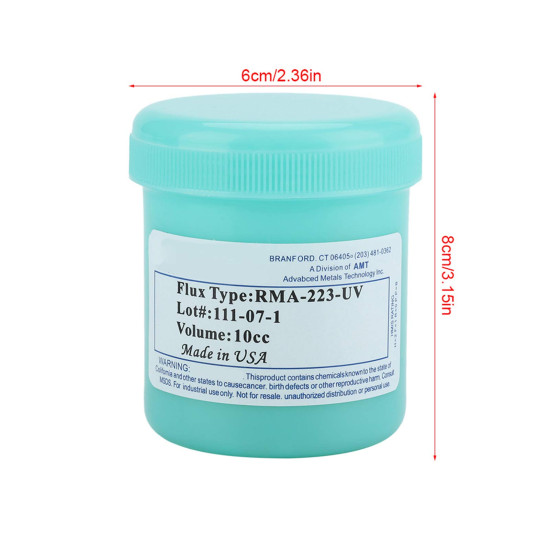
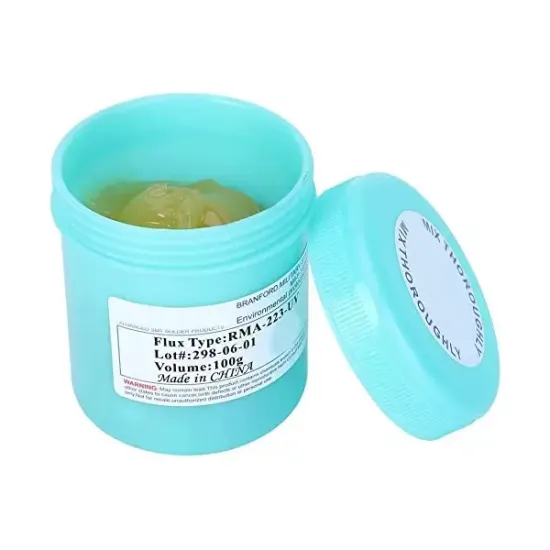
Soldering Flux Amtech RMA-223-TPF(UV) 100g

Soldering Flux Amtech RMA-223-TPF(UV) 100g
KES 2,000.00
  • Stock: In Stock
  • Model: Amtech RMA-223-TPF(UV) 100g
  • Weight: 100.00g
  • Dimensions: 60.00mm x 60.00mm x 65.00mm
  • SKU: 1089

Chemical Composition and Rheological Characteristics

The RMA-223 solder paste flux formulation represents a highly refined, homogeneous mixture engineered specifically for advanced electronic assembly, rework, and surface mount technology (SMT) applications. At its chemical core, RMA-223 utilizes a base of modified natural rosin combined with a mild activation package that incorporates organic acids and non-corrosive halogenated or non-halogenated organic agents. The key functional advantage of this flux blend lies in its sophisticated thixotropic gelling matrix. This special additive mixture provides a tailored shear-thinning response: under external mechanical pressure, such as pneumatic dispensing or manual plunger force, the viscosity drops rapidly to allow smooth, repeatable micro-dispensing without tailing or dripping. Once the shear stress is removed, the rheology instantly restores its structured, high-viscosity state, holding solder spheres or pre-deposited paste accurately in place without slump or physical bridging across neighboring conductors.

This stable suspension prevents the separation or phase segregation of suspended micro-solder alloys over extended operational periods. When blended with pre-alloyed micro-powders, such as Type 3 or Type 4 Sn63Pb37 or lead-free SAC305 particles, RMA-223 holds the metal spheres in an even spatial dispersion. The formulation maintains a controlled viscosity profile, typically falling between 150,000 and 300,000 centipoise (cP) at standard room temperature (25 degrees Celsius). This precise rheology prevents pad-to-pad bridging, reduces solder balling, and ensures excellent wetting energy across copper, tin-lead, immersion gold (ENIG), and silver pad metallizations.

ANSI and IPC J-STD Conformance Standards

RMA-223 is synthesized to strictly satisfy the requirements set forth in ANSI and IPC J-STD-004 and J-STD-006 industry standards for electronic soldering materials. Under the standard flux classification system, RMA-223 corresponds to an ROL1 or ROL0 Rosin Mildly Activated flux type. This indicates that the total halide content within the flux formula remains under 0.5 percent by weight, ensuring high thermal activity during heating while retaining benign, non-corrosive properties after reflow.

The standard ensures that post-solder residues do not readily promote electrolytic copper corrosion or dendritic growth under biased humidity tests. Electrical insulation testing confirms that the amber residue maintains high Surface Insulation Resistance (SIR), exceeding 100 Megaohms in standard environmental stress screening. Consequently, while post-solder cleaning with solvent or isopropyl alcohol is recommended for high-reliability aerospace or medical electronics, the clear, non-conductive residue can often remain safely on commercial printed circuit assemblies without causing signal degradation or leakage current.

Advanced Thermal Profiling and Reflow Kinetics

The thermal dynamic response of RMA-223 is engineered to align with standard SMT reflow profiles, hot-air rework profiles, and manual soldering iron thermal curves. Thermal activation initiates at approximately 100 degrees Celsius, where the flux gel liquifies and spreads uniformly over the joint area. Between 130 degrees Celsius and 170 degrees Celsius, the active organic agents vigorously react with copper oxides, tin oxides, and atmospheric oxygen, dissolving oxidation layers and lowering the surface energy of the metallic substrates.

During the peak liquidus phase (reaching 215 degrees Celsius to 225 degrees Celsius for eutectic leaded alloys, or 240 degrees Celsius to 250 degrees Celsius for lead-free alloys), RMA-223 maintains chemical integrity without prematurely charring or burning off. The flux sustained surface tension promotes strong capillary action, pulling molten solder into fine micro-vias and around dense pin arrays while pushing out trapped gases. This controlled degassing minimizes voiding in the intermetallic compound (IMC) layer, resulting in smooth, mirror-like solder joints with optimal mechanical shear strength and long-term fatigue resistance.

1. Fine-Pitch Quad Flat Package (QFP) Microcontroller ICs

When soldering fine-pitch QFP devices with pin pitches ranging from 0.8mm down to 0.4mm, bridging between adjacent pins is a primary defect mechanism. Applying RMA-223 across the perimeter footprint creates a protective, oxide-free liquid blanket. During hot air reflow or drag-soldering with a mini-wave tip, the high surface tension imparted by the flux pulls excess molten solder away from the space between pins and draws it onto the tin-plated copper leads. The pinout structure of typical 64-pin or 100-pin MCUs demands pristine isolation between adjacent power (VDD), ground (VSS), and high-speed clock pins (XTAL1/XTAL2). RMA-223 prevents microscopic solder webbing across these critical high-impedance channels, mitigating electrical short-circuits and cross-talk.

2. Ball Grid Array (BGA) Reballing and IC Attachment

BGA rework requires uniform thermal transfer and consistent flux tackiness across hundreds of arrayed solder spheres under the IC substrate. In a typical BGA pinout array (e.g., a 256-ball matrix with 0.8mm pitch), missing or uneven flux application leads to un-melted spheres, cold joints, or collapsed balls causing adjacent-pin shorting between ground planes and sensitive data buses (such as DDR memory address lines). RMA-223 acts as a high-tack temporary adhesive holding 0.45mm to 0.6mm solder spheres in exact alignment with the underlying BGA substrate pads during reballing stencil heating. Its consistent thermal breakdown prevents the flux from boiling rapidly, which could otherwise displace spheres out of their designated matrix positions prior to reaching liquidus temperature.

3. Sub-Millimeter SMD Passive Component Arrays (0201 and 0402 Form Factors)

Ultra-small passive components, such as 0201 and 0402 ceramic capacitors and thick-film resistors, are exceptionally vulnerable to tombstoning (unequal surface tension lifting one side of the component vertically). Applying RMA-223 ensures equalized wetting force on both terminal pads simultaneously. On high-density system boards featuring mixed analog and digital signal pinouts, decoupling capacitors connected directly between IC power pins and ground pads benefit from consistent, void-free solder joint geometries that optimize high-frequency decoupling performance and lower Equivalent Series Resistance (ESR).

4. Multi-Pin Male and Female Interface Header Pin Arrays

Board-to-board connectors and standard 2.54mm or 1.27mm pitch header arrays feature tall metallic pin posts prone to rapid thermal dissipation and localized oxidation. When hand-soldering or reworking these connector assemblies, RMA-223 coats the vertical shaft of each pin, facilitating fast, even thermal transfer from the soldering iron tip to the through-hole annular ring or surface-mount pad. This rapid wetting prevents prolonged heat application, protecting sensitive thermal plastics from melting while ensuring complete fillet formation around signal, power, and ground pins across the entire pinout strip.

5. Quad Flat No-Lead (QFN) Packages with Central Ground Thermal Pads

QFN devices feature peripheral signal pads paired with a large central exposed ground pad designed for electrical grounding and thermal dissipation. A frequent issue during QFN assembly is voiding under the large ground plane pad due to trapped flux gases, which severely degrades thermal dissipation pathways. RMA-223 formulated gelling matrix facilitates outgassing during the soak stage of the reflow cycle. When hot air is applied, the flux cleanly escapes from underneath the central pad ground geometry while ensuring complete wetting across outer signal pinouts, including sensitive input voltage (VIN), enable (EN), and feedback (FB) regulator lines.

6. Small-Outline Transistor (SOT-23 / SOT-223) and SOIC Power Management ICs

Power semiconductors in SOT-23, SOT-223, or SOIC-8 packages often feature high-current pinouts (Gate, Drain, Source or Collector, Emitter, Base) situated adjacent to low-power feedback connections. Heat sinking through thick copper board layers makes localized joint formation challenging. RMA-223 maintains active chemical reduction across extended dwell times, allowing high thermal mass pads (such as the Drain tab on SOT-223 packages) to achieve full wetting without scorching the flux or creating brittle intermetallic structures on adjacent lower-mass signal pins.

7. Heavy-Gauge Wire Lead Termination on Dense PCB Through-Holes

Soldering thick multi-strand copper wires directly into multi-layer PCB through-hole vias demands a flux capable of deep capillary penetration. RMA-223 coats the individual copper strands within the wire bundle, preventing oxidation as heat travels up the conductor. When solder is applied to the board joint, the flux pulls the liquid metal up through the plated through-hole via, forming a continuous 360-degree top and bottom fillet. This ensures maximum mechanical strain relief and ultra-low resistance connection for high-current power input ground wire pinouts.

8. Flexible Printed Circuit (FPC) Micro-Connector Assemblies

FPC connectors feature fragile polyimide substrates and extremely thin copper traces with tight 0.3mm or 0.5mm lead spacing. High soldering temperatures easily damage these flexible substrates. RMA-223 reduces the required contact time and liquidus dwell temperature by rapidly lowering surface tension. This fast-acting activation allows technicians to repair or align delicate FPC micro-pinouts using lower iron temperatures (around 300 degrees Celsius), preserving substrate flexibility and preventing pad trace delamination.

Surface Insulation Resistance and Post-Reflow Residue Dynamics

Following thermal processing, RMA-223 leaves behind a smooth, light amber, transparent residue layer. Unlike fully activated acid fluxes (OA types) that contain corrosive organic salts requiring mandatory water wash cycles, RMA-223 non-conductive rosin matrix encapsulates any unreacted activation agents. This encapsulation prevents atmospheric moisture from reacting with micro-quantities of halide ions, maintaining a high Surface Insulation Resistance (SIR) value across fine-pitch conductor traces. For ultra-sensitive high-frequency RF circuits or high-impedance analog sensor pinouts where parasitic capacitance or nano-amp leakage currents could alter performance, the amber residue can be effortlessly removed using solvent sprays, ultrasonic isopropyl alcohol baths, or specialized aqueous cleaning agents.

Storage Protocol, Handling Standards, and Dispensing Calibration

To preserve the thixotropic suspension and prevent premature evaporation of volatile solvent components, RMA-223 syringes should be stored vertically with tip caps tightly secured in a cool, controlled environment (between 5 degrees Celsius and 20 degrees Celsius). Prior to application, the syringe should be allowed to stabilize at ambient room temperature for approximately two hours to restore its designed dispensing viscosity. Standard Luer-lock dispensing tips ranging from 18-gauge for large pads down to 27-gauge for micro-SMD pad arrays can be directly fitted onto the syringe barrel for precise automated pneumatic or manual hand application.

Ginō Ginō AI - Nerokas AI Assistant
✕
Jambo! I am Ginō, a Nerokas AI Assistant and Africa's best Open Hardware Facilitator AI agent here to help. In order to serve you better and to help me give you accurate shipping estimates as we begin, could you please tell me your name and your location/city?

You can also ask about any hardware or type I'd like to order, I am looking for..., you can also LIST all SKUs & Quantity of desired items from our website here for me to help you Checkout automatically at anytime to fast-track your requests and orders.