Menu
Your Cart
NOTICE: We have Fully discontinued physical walk-in customer service, RFQ, and LPO processing. Nerokas is now a FULLY DIGITAL ONLINE STORE, and our virtual assistant, Ginō AI, is here to help you navigate and checkout. Just ADD your Items to cart and type CHECKOUT on Ginō. Please note that corporate customers must register a corporate account to ensure proper Digital eTIMS/VAT processing.

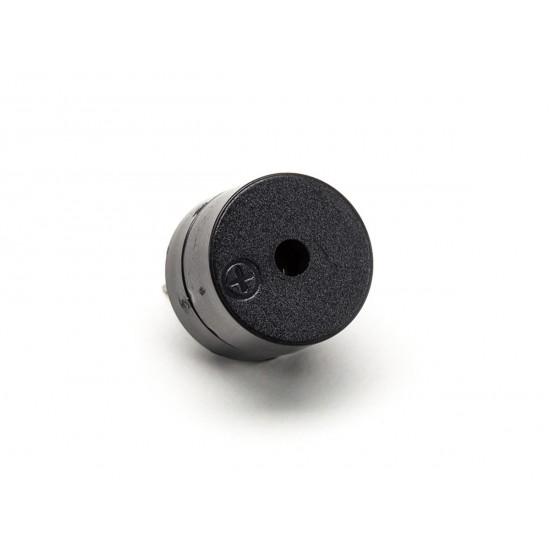
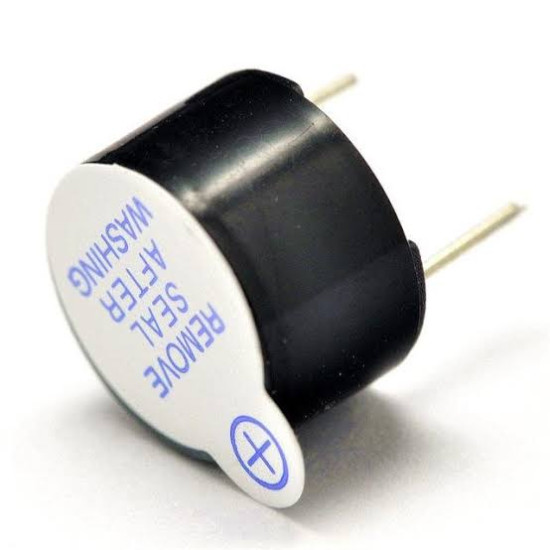
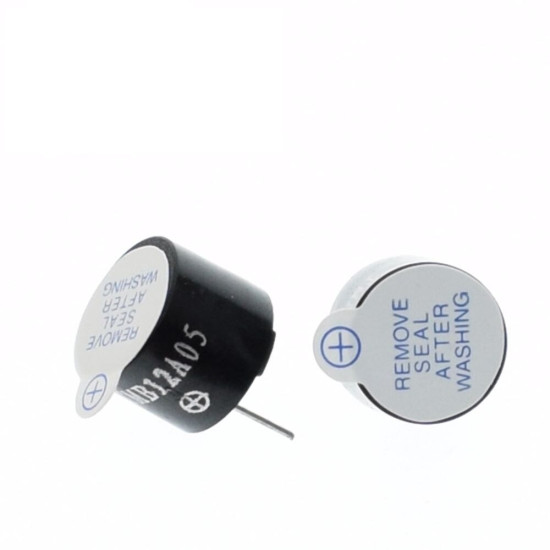
Buzzer Piezoelectric Active

Buzzer Piezoelectric Active
Top Seller
Buzzer Piezoelectric Active
KES 50.00
  • Stock: In Stock
  • Model: YD1407
  • Weight: 1.80g
  • Dimensions: 12.00mm x 12.00mm x 9.50mm
  • SKU: 1102

Architectural Overview and Acoustic Engineering

The 13.8mm x 7.5mm Piezoelectric Audio Transducer Buzzer is a high-efficiency electro-acoustic component designed for reliable audible signaling across industrial, commercial, and embedded electronics applications. Engineered around a precision-poling Lead Zirconate Titanate (PZT) ceramic disk bonded to a resonant brass substrate, this compact acoustic indicator converts electrical signals into crisp, clean sound waves with exceptional electro-acoustic energy conversion efficiency. Measuring precisely 13.8 mm in outer diameter with a low-profile height of 7.5 mm, this ultra-lightweight 1.0-gram transducer offers high acoustic output while maintaining a minimal PCB footprint.

Unlike traditional magnetic buzzers that rely on electromagnetic coils, voice coils, and physical armatures to generate sound, this piezoelectric transducer operates without moving mechanical parts subject to frictional wear. This solid-state construction inherent to piezoceramic technology eliminates electromagnetic interference (EMI) back-EMF spikes during operation, rendering it ideal for integration into sensitive microcontroller-based systems, wireless nodes, and low-power telemetry setups. The acoustic chamber embedded within the 7.5mm housing is mathematically tuned to amplify the fundamental 4.0 kHz resonant frequency, generating a minimum Sound Pressure Level (SPL) of 83 dB at a 10 cm test distance when supplied with its rated operating conditions.

Electromechanical and Physical Mechanics

The physical mechanical operation of this buzzer relies on the inverse piezoelectric effect. When an electric potential differential is applied across the electrodes attached to the opposite faces of the PZT ceramic disc, the crystalline lattice structure undergoes dimensional deformation. Applying a positive DC voltage produces mechanical contraction or expansion depending on the poling orientation, causing the bonded metallic substrate disk to flex outward or inward. Reversing or collapsing the applied electric field allows the metallic diaphragm to snap back to its rest position.

By driving the transducer with an alternating or pulsed DC waveform centered at its natural mechanical resonant frequency of 4.0 kHz (4000 Hz), the mechanical flexing reaches maximum amplitude due to acoustic resonance within the internal physical cavity. This 4.0 kHz center frequency aligns closely with the peak human auditory perception sensitivity range (typically between 2 kHz and 5 kHz), allowing the device to deliver clear, unmistakable audible alerts even in ambient noise environments while consuming less than 7 mA of supply current at nominal 12VDC operation.

Deep Technical Specifications

Understanding the exact operating boundaries and electrical characteristics of this piezo transducer is critical for optimizing drive topology and power budgeting within embedded circuit designs:

Rated Voltage: 12VDC nominal. Driven at 12VDC, the transducer delivers optimal acoustic displacement and sound pressure output without thermal overload or ceramic polarization decay.

Operating Voltage Range: 3VDC to 16VDC. The ultra-wide input voltage window allows direct operation from various system power rails including 3.3V logic arrays, 5V USB buses, 9V alkaline battery systems, and standard 12V industrial or automotive DC buses.

Maximum Rated Current: 7mA at 12VDC. The low current draw makes this transducer far more power-efficient than electromagnetic buzzers which often demand 30mA to 100mA, preserving overall battery life in portable products.

Minimum Sound Pressure Level (SPL): 83dB measured at a distance of 10cm under 12VDC drive. Following the inverse-square law for acoustic propagation, this translates to roughly 63dB to 65dB at 1 meter, offering strong signal penetration for user feedback.

Resonant Frequency: 4.0 kHz (plus or minus 500 Hz tolerance). Maximum acoustic intensity is achieved when driven by a square wave or continuous tone at exactly 4000 Hz.

Tone Nature: Single tone / Continuous. When supplied with a constant DC voltage (for internally driven active models) or a fixed-frequency signal (for passive drive setups), the unit generates an unwavering continuous acoustic pitch.

Operating Temperature Window: -20 degrees Celsius to +70 degrees Celsius. Operating capabilities across extreme thermal environments make it suited for outdoor gear, industrial automation cabinets, and automotive cabin environments.

Physical Dimensions and Weight: Base diameter of 13.8 mm, enclosure height of 7.5 mm, total weight of 1.0 gram.

Electrical Interface, Driving Circuits, and Pinout Configurations

Integrating this piezoelectric audio transducer into an electronic system requires an understanding of its capacitive load characteristics. Electromechanically, a piezo ceramic disc acts electrically like a parallel capacitor (typically ranging between 10 nF and 30 nF depending on mechanical dimensions and electrode surface area). Driving a capacitive load requires proper driver configuration to ensure rapid charging and discharging of the element without ringing or slow edge transitions.

For microcontrollers such as AVR, STM32, PIC, or ESP32, direct driving via a single GPIO pin is possible at lower voltages (3.3V to 5V), but driving the buzzer at its full 12VDC potential requires an external low-side N-channel MOSFET (such as a 2N7002 or BSS138) or a general-purpose NPN bipolar junction transistor (BJT, such as an MMBT3904 or BC847). A pull-down or parallel discharge resistor (typically 1k ohm to 10k ohm) connected across the piezo terminals assists in rapidly discharging the stored capacitive charge during signal OFF cycles, resulting in sharp, distinct acoustic pulses and preventing muddy tone transitions.

Pinout and Connection Architecture Explained

The standard dual-terminal pin configuration of the 13.8mm x 7.5mm Piezoelectric Buzzer is simple, polarization-aware, and streamlined for easy assembly on printed circuit boards or via wire harness connections:

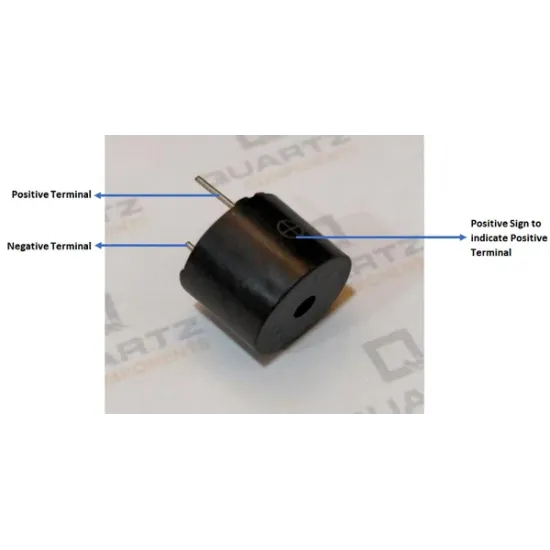
Pin 1: Positive Terminal / Anode (+ / Red Lead or Long Pin)
The positive connection terminal is designated by a plus symbol etched into the top PBT housing or identified by a longer lead/red insulated wire. This terminal connects directly to the positive switched DC supply voltage (3VDC to 16VDC) or to the high-side output of a push-pull driver stage. In low-side switching networks, Pin 1 is wired to the VCC rail (e.g., +12V), while the switching transistor controls the return path to ground.

Pin 2: Negative Terminal / Cathode (- / Black Lead or Short Pin)
The negative connection terminal serves as the current return path and connects to the collector (in NPN transistor driver topologies), the drain (in N-channel MOSFET switching configurations), or directly to common System Ground (GND) when high-side P-channel MOSFET switching is utilized. Ensuring proper polarity maintains optimal mechanical deflection in accordance with the factory ceramic poling direction.

Acoustic Cavity Design and Resonant Tuning

The 7.5mm vertical height of the buzzer housing plays a vital structural role beyond simply protecting the internal ceramic disc. The housing forms a Helmholtz acoustic resonant cavity. Sound generated by the vibrating PZT diaphragm propagates through the front sound outlet hole located on the top surface of the plastic shell. The volume of air inside the cavity combined with the diameter and length of the sound orifice acts as an acoustic low-pass and band-pass filter that peaks at 4.0 kHz.

When mounting this component onto a enclosure panel or inside an outer product housing, care must be taken not to obstruct the top sound release hole. Covering or potting over the sound aperture shifts the acoustic impedance, resulting in a dramatic drop in sound output (attenuation up to 20dB to 30dB) and detuning the 4.0 kHz primary frequency resonance.

Application Use-Cases

1: Industrial Automation Alarm Panels

In industrial programmable logic controller (PLC) cabinets, human-machine interfaces (HMIs), and assembly line control boxes, clear audible indicators are mandatory to signal state changes, fault conditions, emergency stops, or process completions. The wide 3-16VDC operating range permits seamless integration into standard 12V auxiliary DC control buses without requiring dedicated step-down voltage regulators. The 83dB output ensures that operators hear crucial diagnostic alerts above background machinery humming, while the low 7mA current draw avoids straining control panel power budgets.

2: Medical Device Auditory Alert Systems

Medical monitoring equipment, infusion pumps, blood pressure monitors, and bedside telemetry systems require dependable, non-ignorable audio alerts to notify healthcare staff of alarm conditions, low battery states, or fluid line obstructions. Operating at 4.0 kHz provides high human auditory sensitivity, ensuring rapid reaction times from medical personnel. The non-magnetic, EMI-free nature of the piezo element guarantees zero magnetic interference with sensitive bio-potential measurement circuits or nearby imaging hardware.

3: Automotive Dashboard Diagnostic Chimes

Vehicle dashboards, telematics units, and aftermarket automotive gear rely on piezo buzzers for seatbelt reminders, key-in-ignition warnings, turn-signal clicking simulation, and reverse parking sensor proximity alerts. Capable of enduring harsh vehicle cabin thermal fluctuations from -20 degrees Celsius to +70 degrees Celsius, this transducer interfaces directly with 12V automotive power lines, surviving electrical transients when paired with standard automotive TVS protection diodes.

4: Embedded Internet of Things (IoT) Node Beaconing

Battery-powered IoT sensor nodes and wireless mesh field units demand ultra-low power consumption for extended field deployment. Because piezo transducers consume zero static current when inactive and draw under 7mA during active 12V chirps, they are superior to high-current magnetic buzzers. Microcontrollers can rapidly pulse the buzzer at 4.0 kHz for a few milliseconds to indicate network pairing, low-battery status, or data transmission success without draining primary lithium batteries.

5: Security System Tamper and Intrusion Annunciators

Security control panels, door contact sensors, motion detectors, and alarm keypads require internal sounders to provide entry/exit delay countdown chirps, button-press feedback, and local tamper alerts. The compact 13.8mm footprint allows designers to place the unit directly on slim wall-mounted PCBs. When driven continuously at 12VDC, the resulting 83dB sound level creates an uncomfortable local tone that deters unauthorized access and alerts building occupants.

6: Consumer Appliance User Feedback Interface

Modern kitchen appliances such as microwave ovens, induction cooktops, dishwashers, and smart refrigerators use piezo transducers behind capacitive touch panels to supply tactile and acoustic user feedback. Each keypress triggers a short 40ms pulse at 4.0 kHz, assuring the user that their input was registered. The durable PBT plastic construction resists moisture ingress and cleaning chemicals commonly encountered in kitchen environments.

7: Handheld Test Equipment Voltage and Continuity Beeper

Digital multimeters (DMMs), cable testers, and circuit continuity probers rely on instantaneous audible feedback to notify technicians of short circuits or low-resistance connections without requiring them to look away from the test leads. The instantaneous response time of piezoceramic flexing enables immediate audio generation the exact microsecond contact is made, unlike mechanical relays or slow digital audio converters.

8: Unmanned Aerial Vehicle (UAV) Flight Status and Loss-Locator

In drone flight controllers and electronic speed controllers (ESCs), weight is a primary design constraint. Weighing only 1.0 gram, this piezo buzzer adds virtually no payload mass to quadcopters or fixed-wing UAVs. It serves as an arming status indicator, low-voltage battery alarm, and a high-pitched lost-model finder chime activated via remote control telemetry to locate downed aircraft in tall grass or brush.

Environmental Stress Testing and Thermal Reliability

Designed to operate reliably in harsh real-world conditions, this 13.8mm x 7.5mm transducer undergoes thermal shock, mechanical vibration, and humidity exposure testing. Operating across -20 degrees Celsius to +70 degrees Celsius ensures consistent performance from sub-zero outdoor winter installations to hot industrial enclosures. The solid-state internal PZT disk resists mechanical degradation from routine shock and vibration, delivering tens of thousands of operating hours without shift in resonant frequency or drop in acoustic SPL output.

Ginō Ginō AI - Nerokas AI Assistant
✕
Jambo! I am Ginō, a Nerokas AI Assistant and Africa's best Open Hardware Facilitator AI agent here to help. In order to serve you better and to help me give you accurate shipping estimates as we begin, could you please tell me your name and your location/city?

You can also ask about any hardware or type I'd like to order, I am looking for..., you can also LIST all SKUs & Quantity of desired items from our website here for me to help you Checkout automatically at anytime to fast-track your requests and orders.