- Stock: In Stock
- Model: Diffused Red 5mm Through-Hole
- Weight: 0.30
- Dimensions: 26.50 x 5.80 x 5.80
- SKU: 1270
Overview and Optical Characteristics
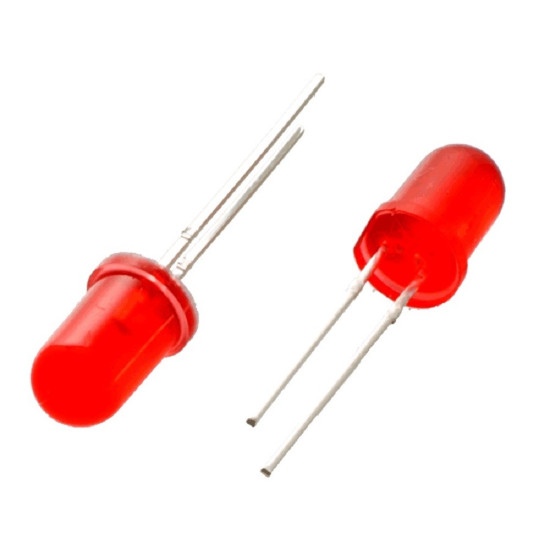
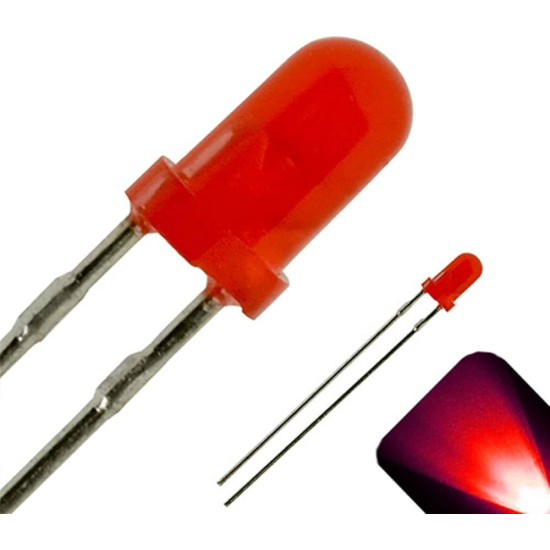
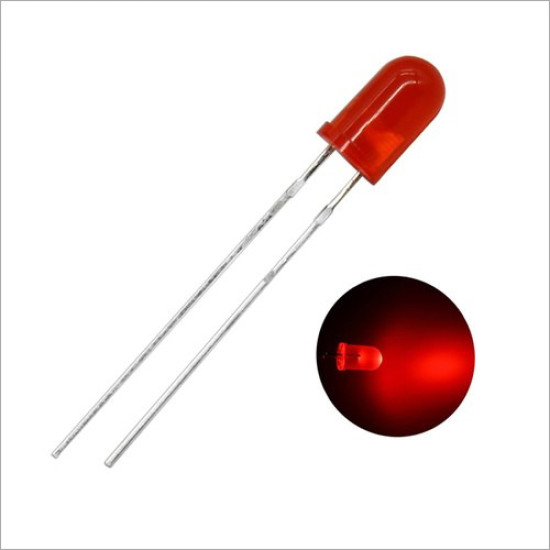
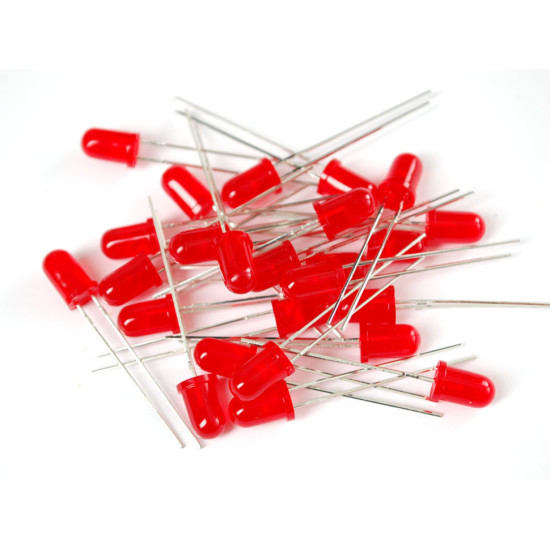
The Diffused Red 5mm LED is a classic T-1 3/4 format optoelectronic indicator engineered for clear, soft visual signaling across a wide spectrum of electronic systems. Featuring a tinted red epoxy lens, this light-emitting diode scatters light uniformly to minimize harsh focal points and glare. The diffused encapsulation ensures excellent off-axis readability with a broad 60 degree viewing angle, making it an essential component for user interface panels, status monitoring, and educational prototype circuits.
Technical Parameters and Electrical Specifications
Operating within a standard forward voltage window of 1.8V to 2.2V (typical 2.0V DC), this solid-state diode draws a continuous forward current of 20mA, achieving optimal luminous intensity around 50 to 100 mcd. The device emits at a dominant wavelength of approximately 625nm to 630nm, producing a vivid red hue. Constructed with durable gallium arsenide phosphide (GaAsP) on gallium phosphide (GaP) semiconductor material, it offers high thermal efficiency, long operational lifespan, and rapid response times suitable for low-frequency pulse-width modulation dimming.
Pinout and Installation Guidelines
Designed with standard 2.54mm (0.1 inch) lead pitch, this through-hole component integrates directly into solderless breadboards, standard perfboards, and printed circuit board assemblies. Polarity identification is straightforward: the longer lead indicates the Anode (positive terminal), while the shorter lead and adjacent flat edge on the epoxy flange denote the Cathode (negative terminal). Always utilize an appropriate series current-limiting resistor calculated via Ohm's Law when driving this LED from 3.3V, 5V, or 12V power rails to prevent overcurrent degradation.
Recommended Applications and Integration
This versatile red LED is widely deployed in embedded systems development with platforms such as Arduino, ESP32, and Raspberry Pi. Common implementation use-cases include power-on state visual indicators, error condition signals, logic level verification displays, automotive dashboard illumination, audio equipment feedback panels, and custom DIY electronic instrumentation.