Menu
Your Cart

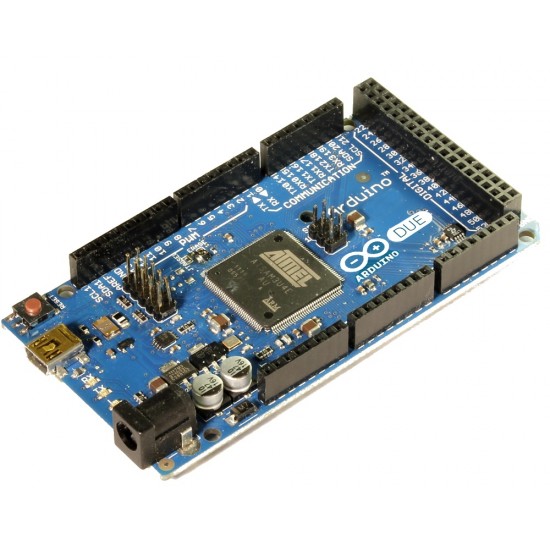
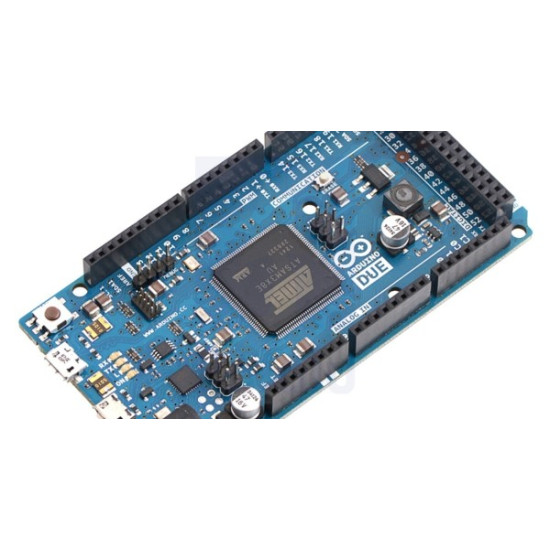
Arduino Due

Arduino  Due
Arduino  Due
Arduino  Due
Arduino  Due
USB CABLE NOT INCLUDED
Arduino  Due
Arduino  Due
Arduino  Due
Arduino  Due
Arduino Due
KES 4,200.00
  • Stock: In Stock
  • Model: Arduino DUE
  • Weight: 36.00g
  • Dimensions: 101.60mm x 53.30mm x 15.00mm
  • SKU: 138

High-Performance 32-Bit Processing Power

The Arduino Due marks a major leap forward in embedded computing performance, utilizing the Microchip/Atmel SAM3X8E ARM Cortex-M3 32-bit microcontroller operating at a rapid 84 MHz clock frequency. Built to handle memory-intensive and computationally demanding projects, this board provides a seamless bridge from standard 8-bit AVR microcontrollers to high-performance ARM architectures. Operating with a Nested Vectored Interrupt Controller (NVIC) and hardware single-cycle multiply/divide instructions, the Cortex-M3 core handles complex multitasking and real-time execution with low latency. Retaining native compatibility with the familiar Arduino IDE, C/C++ libraries, and software API, code migration occurs effortlessly, enabling developers to execute advanced digital signal processing routines, real-time control algorithms, and rapid data acquisition without refactoring core control logic.

MicrocontrollerAT91SAM3X8E
Operating Voltage3.3V
Input Voltage (recommended)7-12V
Input Voltage (limits)6-16V
Digital I/O Pins54 (of which 12 provide PWM output)
Analog Input Pins12
Analog Output Pins2 (DAC)
Total DC Output Current on all I/O lines130 mA
DC Current for 3.3V Pin800 mA
DC Current for 5V Pin800 mA
Flash Memory512 KB all available for the user applications
SRAM96 KB (two banks: 64KB and 32KB)
Clock Speed84 MHz
Length101.52 mm
Width53.3 mm
Weight36 g

Advanced Hardware Architecture and Memory Subsystem

Featuring a sophisticated internal bus matrix and memory organization, the board integrates 512 KB of Flash memory split into two 256 KB banks, enabling dual-bank read-while-write functionality for secure bootloader operations and firmware updates. Memory bottlenecks are eliminated thanks to 96 KB of high-speed SRAM divided into two contiguous blocks (64 KB SRAM0 and 32 KB SRAM1). To maximize throughput, the SAM3X8E features a Peripheral DMA Controller (PDC) that offloads memory transfer tasks directly from the CPU core during high-speed SPI, UART, and analog sample processing, preventing frame drops and CPU stalls during continuous data streaming.

Comprehensive I/O Density and Precision Analog Capabilities

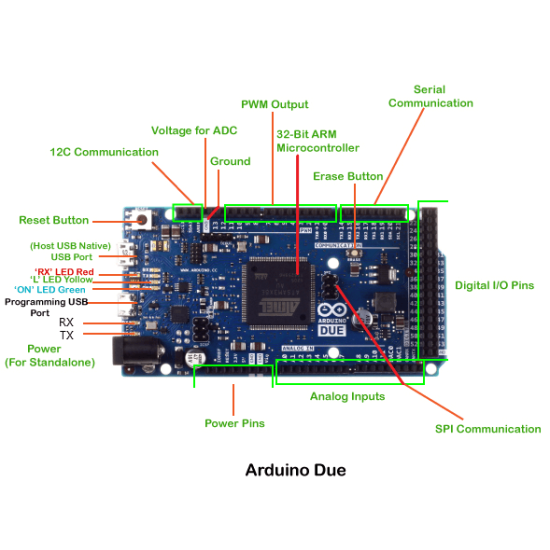
Offering an extensive array of interface options, the board breaks out 54 digital input/output pins, 12 of which support precise hardware Pulse Width Modulation (PWM) with configurable frequency and duty cycle. The analog subsystem includes 12 analog inputs multiplexed to a high-speed 12-bit Analog-to-Digital Converter (ADC) capable of sampling rates up to 1 MSPS. Furthermore, the board includes two true 12-bit Digital-to-Analog Converter (DAC) channels, enabling accurate hardware generation of audio signals, arbitrary waveforms, and direct analog voltage outputs without external RC filtering.

Industrial Connectivity and Dual-USB Functionality

Designed for advanced networking and peripheral bridging, the board incorporates two controller area network (CAN 2.0A/B) controllers, allowing direct integration into automotive and industrial CAN networks via external transceivers. Communication peripherals also include four hardware UART serial ports, two TWI/I2C buses, a dedicated SPI bus header, and a high-speed JTAG debugging header. The dual-USB port architecture features a Programming Port driven by an ATmega16U2 for steady serial interface uploads and standard serial debugging, alongside a Native USB Port tied directly to the SAM3X8E core. This native controller acts as a USB Host or Device, supporting standard Human Interface Device (HID) emulation, mass storage classes, and Android Open Accessory (ADK) protocols.

Critical Electrical Characteristics and Operating Safety

Unlike legacy 5V Arduino development platforms, the SAM3X8E microcontroller operates strictly at a 3.3V logic level. Each general-purpose input/output pin is rated exclusively for 3.3V maximum input voltage with limited sink/source current limits (typically 3 mA to 15 mA depending on the specific pin). Exceeding 3.3V on any I/O pin, such as directly connecting unbuffered 5V sensor outputs or 5V power rails, will cause permanent hardware damage to the SAM3X8E silicon core. System integrators must deploy active bi-directional logic level shifters or precision resistor voltage dividers when interfacing with 5V sensors, legacy shields, or standard 5V logic modules. The board can be powered via an external DC barrel jack accepting 7V to 12V DC, regulated onboard to stable 3.3V and 5V supply rails.

Target Applications and Implementation Use-Cases

The massive computational bandwidth, hardware DMA, and analog capabilities make this board ideal for demanding engineering applications including high-fidelity digital audio synthesis, software-defined radio processing, complex multi-axis 3D printer and CNC motion control systems, real-time robotics inverse kinematics calculations, rapid high-frequency sensor data logging, and industrial automation via standard CAN networks. Its dual-USB port configuration allows for both high-speed firmware deployment and direct hardware emulation of custom USB peripheral controllers.

Official Resources & Manuals

Ginō Ginō AI - Nerokas AI Assistant
Jambo! I am Ginō, a Nerokas AI Assistant and Africa's best Open Hardware Facilitator AI agent here to help. In order to serve you better and to help me give you accurate shipping estimates as we begin, could you please tell me your name and your location/city?

You can also ask about any hardware or type I'd like to order, I am looking for..., you can also LIST all SKUs & Quantity of desired items from our website here for me to help you Checkout automatically at anytime to fast-track your requests and orders.