





















- Stock: In Stock
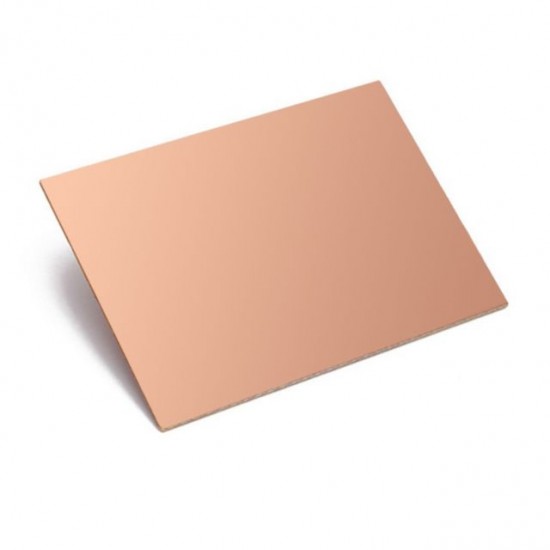
- Model: Copper Clad D.S 15 x 20 1.6mm
- Weight: 95.00g
- Dimensions: 200.00mm x 150.00mm x 1.60mm
- SKU: 243
High-Grade FR4 Copper-Clad Board Substrate Overview
Engineered to meet the stringent demands of modern electronic prototyping and low-volume production, this 150mm x 200mm single-sided copper-clad laminate serves as a premium substrate for custom printed circuit board (PCB) fabrication. Formulated from high-density, flame-retardant FR-4 woven fiberglass interwoven with a high-performance epoxy resin matrix, this blank laminate provides superior mechanical rigidity, minimal thermal expansion, and exceptional electrical insulation properties. Whether constructing high-frequency signal paths, low-noise analog circuits, or general power regulation modules, this substrate guarantees baseline structural integrity and low-loss dielectric performance across a broad spectrum of operating frequencies.
Deep Technical Specifications and Thermal Performance
Featuring a standardized substrate thickness of 1.6mm, this board provides exceptional flexural strength and planar flatness under mechanical strain. The top layer comprises a uniform, high-purity electrodeposited copper foil with a density of 1oz per square foot (approximately 35 microns in thickness). This thickness provides optimal balance between high current-carrying capacity, low DC resistance, and clean trace definition during trace isolation. The underlying FR-4 dielectric exhibits a glass transition temperature (Tg) between 130 and 140 degrees Celsius, resisting thermal deformation, pad lifting, substrate charring, and delamination during sustained hand soldering, surface-mount device hot-air rework, and wave soldering processes. With a dielectric constant (Er) of 4.3 to 4.5 at 1 MHz and a low dissipation factor, signal integrity and impedance consistency remain stable throughout high-density circuit layouts.
Manufacturing Compatibility and Precision Prototyping Workflows
This blank copper substrate is optimized for seamless integration across a comprehensive range of rapid prototyping techniques. For chemical subtractive processes, it demonstrates fast, predictable etch rates when exposed to ferric chloride, ammonium persulfate, or sodium persulfate solutions. In optical and photoresist transfer methods, the smooth micro-polished copper surface ensures maximum adhesion for UV photoresist dry films, positive photopolymers, and direct toner transfer papers. For digital subtractive manufacturing, the rigid fiber matrix reduces burring during isolation milling, drilling, and contour routing on desktop CNC PCB routers. Common technical applications include high-voltage power distribution blocks, custom microcontroller development platforms, RF ground planes, electromagnetic shielding enclosures, and university electronic engineering laboratory research.