Menu
Your Cart
NOTICE: We have Fully discontinued physical walk-in customer service, RFQ, and LPO processing. Nerokas is now a FULLY DIGITAL ONLINE STORE, and our virtual assistant, Ginō AI, is here to help you navigate and checkout. Just ADD your Items to cart and type CHECKOUT on Ginō. Please note that corporate customers must register a corporate account to ensure proper Digital eTIMS/VAT processing.

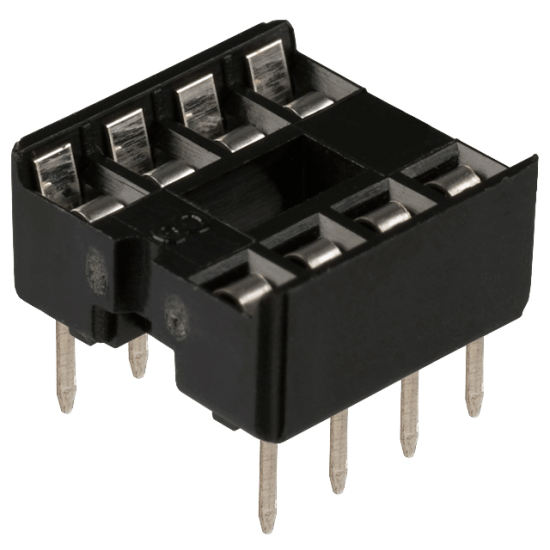
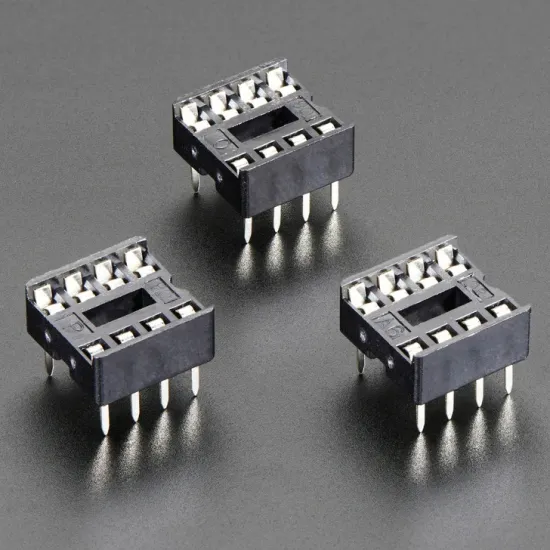
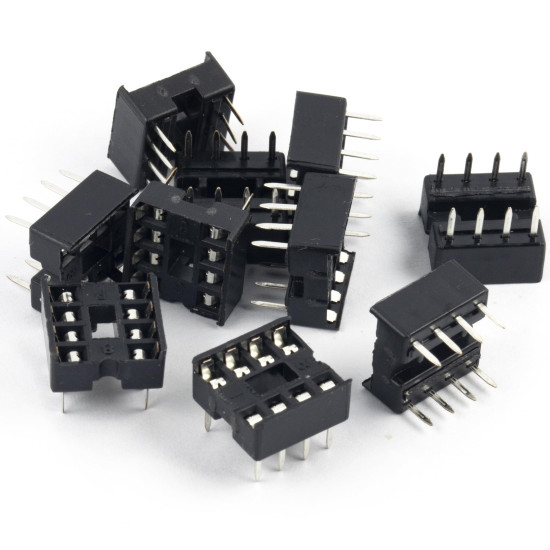
8 Pin DIP IC Socket

8 Pin DIP IC Socket
8 Pin DIP IC Socket
8 Pin DIP IC Socket
8 Pin DIP IC Socket
Top Seller
8 Pin DIP IC Socket
8 Pin DIP IC Socket
8 Pin DIP IC Socket
8 Pin DIP IC Socket
8 Pin DIP IC Socket
KES 10.00
  • Stock: In Stock
  • Model: IC Socket
  • Weight: 0.65g
  • Dimensions: 10.16mm x 10.16mm x 7.80mm
  • SKU: 260

Executive Summary and Technical Overview

The GTK 8-Pin Dual In-Line Package (DIP) IC Socket represents a benchmark solution for component-level interconnect systems in modern electronic manufacturing, repair, and prototyping. Engineered to facilitate seamless component installation, thermal isolation, and simplified field maintenance, this socket eliminates the need to directly solder sensitive 8-pin integrated circuits (ICs) onto printed circuit boards (PCBs). By establishing a reliable, intermediate physical and electrical bridge between the integrated circuit leads and the PCB traces, the GTK DIP-8 socket protects delicate silicon dies from thermal overstress during wave soldering or manual assembly operations.

Featuring a standard 2.54mm (0.1 inch) pin pitch and a 7.62mm (0.3 inch) row-to-row spacing, this socket strictly adheres to standard industry dimensions for narrow-body DIP ICs. Manufactured by GTK with full RoHS compliance, this component incorporates dual-wipe contact geometry, ensuring low contact resistance, high normal force, and superior vibration tolerance over extended operational lifespans. Whether deployed in automated high-volume production lines or targeted development environments, this socket provides exceptional durability, structural rigidity, and electrical continuity for low-voltage, analog, and digital applications.

Mechanical Construction and Dual-Wipe Contact Engineering

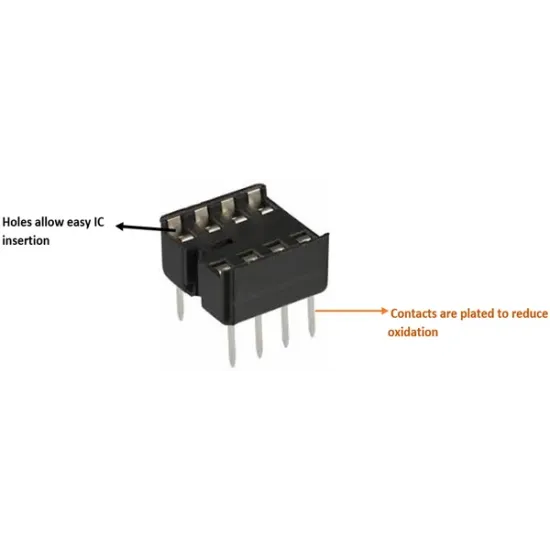
The core mechanical innovation of the GTK 8-Pin socket lies in its dual-wipe contact architecture. Standard single-beam sockets rely on a single contact surface pressing against the IC pin, which leaves the electrical connection vulnerable to oxidation, mechanical shock, fretting corrosion, and thermal expansion mismatch. In contrast, GTK dual-wipe contacts feature two opposing cantilevered metallic spring beams that pinch both broad sides of the flat IC lead simultaneously.

This dual-point engagement doubles the contact surface area and creates a self-cleaning wiping action upon IC insertion. As the chip lead enters the socket terminal, the wiping movement cuts through surface oxide layers, dust, and contaminants, establishing a pristine metal-to-metal connection. The contacts are stamped from high-grade phosphor bronze or copper alloy, providing excellent yield strength, resistance to mechanical fatigue, and sustained wiping pressure across multiple insertion and extraction cycles. The total pin length of 2.9mm is optimized for standard 1.6mm thick double-sided or multi-layer PCBs, leaving sufficient tail projection for reliable solder fillet creation on the bottom copper layer without extending excessively into tight enclosure clearances.

Electrical Performance and Signal Integrity

Signal integrity and transmission efficiency are paramount in modern mixed-signal, high-speed analog, and microcontroller circuits. The GTK DIP-8 socket features ultra-low contact resistance, typically measuring under 20 milliohms per pin contact pair, minimizing voltage drops and resistive heating across the connection point. The high dielectric strength of the thermoplastic insulator housing prevents inter-pin leakage currents, maintaining high isolation resistance exceeding 1000 Megaohms at 500V DC between adjacent contacts separated by the 2.54mm pitch.

Parasitic capacitance between adjacent pins is kept below 1.0 pF, while parasitic self-inductance is minimized by the compact 2.9mm pin length and optimized internal geometry. This enables the socket to support signal switching frequencies ranging from DC up to dozens of Megahertz without introducing noticeable distortion, signal attenuation, or phase shift. Current carrying capacity is rated up to 1A per pin, making the socket suitable not only for signal-level microcontrollers and operational amplifiers, but also for low-power motor drivers and localized voltage regulation ICs.

Pinout Architecture and Structural Layout

The physical geometry of the GTK 8-pin DIP socket follows the standardized dual in-line layout, arranged in two parallel rows of 4 pins each. The spacing between adjacent pins along the same row is precisely 2.54mm (0.100 inches), while the lateral separation between the centerlines of the two parallel pin rows is 7.62mm (0.300 inches). The socket body incorporates a distinct polarization notch at one short edge, designating the location of Pin 1 in strict alignment with standard IC packaging norms.

When viewing the socket from the top with the polarization notch positioned at the top (12 o'clock position), the pin numbering proceeds counter-clockwise from Pin 1 down to Pin 4 on the left column, and continues across to Pin 5 at the bottom right up to Pin 8 at the top right. Pin 1 is top-left, Pin 2 is upper-middle-left, Pin 3 is lower-middle-left, Pin 4 is bottom-left, Pin 5 is bottom-right, Pin 6 is lower-middle-right, Pin 7 is upper-middle-right, and Pin 8 is top-right. The central open-frame body design permits unimpeded air circulation beneath the installed IC and allows for visual inspection of traces, vias, or surface-mount passive components positioned directly under the socket on the host PCB.

Precision Operational Amplifier Sockets

In high-fidelity audio equipment, instrumentation amplifiers, and active filter topologies, 8-pin dual op-amps such as the NE5532, TL072, OPA2134, and LM358 are widely utilized. Placing these high-gain analog devices in the GTK DIP-8 socket enables rapid component swapping, commonly known as op-amp rolling, allowing audio engineers and enthusiasts to evaluate different operational amplifiers to tune harmonic character, noise floor, slew rate, and total harmonic distortion (THD) without re-soldering and risking thermal damage to the PCB pads.

555 Timer Circuit Modular Prototyping

The ubiquitous 555 timer IC (e.g., NE555, LM555) remains a foundational component for pulse generation, timing delays, duty-cycle modulation, and oscillator applications. Utilizing the GTK 8-pin socket in educational development boards, industrial control panels, and timing modules protects the timer IC from high duty-cycle thermal stress and enables field technicians to rapidly replace units degraded by high-voltage inductive kickbacks or voltage spikes on power rails.

Microcontroller and EEPROM Interfacing

8-pin microcontrollers like the Microchip ATtiny85, PIC12F series, and I2C/SPI serial EEPROM chips such as the 24LC256 or 93C46 are frequently used in embedded systems. Socketing these memory and processing units with the GTK 8-pin DIP socket allows firmware programmers to physically extract the chips for external high-speed device programming or off-board EEPROM data flashing, eliminating the need for expensive in-circuit serial programming (ICSP) headers or complex bootloader implementations on space-constrained boards.

Optocoupler and Galvanic Isolation Modules

High-voltage power electronics and industrial automation systems rely on 8-pin dual optocouplers (such as the 6N137 or HCPL-2630) to isolate sensitive control logic from high-voltage AC or DC power stages. When electrical transients, surges, or ground loops damage the optical isolation barrier, the GTK socket facilitates quick replacement of the blown optocoupler chip without taking the entire motherboard offline or risking delamination of multi-layer PCB traces during field repairs.

MOSFET Gate Driver and Power Management ICs

In switched-mode power supplies (SMPS), motor controllers, and DC-DC converters, 8-pin gate driver ICs (such as the TC4420 or IR2110) drive high-power MOSFETs and IGBTs. Gate drivers operate under severe electrical stress and localized thermal dissipation. Installing these ICs via the GTK DIP-8 dual-wipe socket ensures low-inductance connection to the gate lines while providing a heat-isolated socket footprint that tolerates component replacement upon catastrophic power stage failures.

RS-485 and RS-232 Transceiver Interfaces

Industrial communications networks utilize 8-pin transceiver ICs like the MAX485 or SN75176 for long-distance RS-485 serial buses. Because communication lines exposed to external cabling are highly susceptible to electrostatic discharge (ESD), lightning surges, and improper wiring faults, these transceivers frequently act as sacrificial components. Integrating the GTK 8-pin socket ensures maintenance technicians can perform instant field restoration by replacing compromised transceivers on site.

Analog Sensor Front-End Interfaces

Precision temperature measurement circuits (utilizing 8-pin signal conditioners like the AD698 or MAX6675) and pressure transducer amplifiers require low-drift, noise-free interconnections. The dual-wipe contact design of the GTK socket delivers high-contact normal forces that mitigate fretting corrosion and contact resistance drift, ensuring that microvolt-level analog signals generated by delicate sensor elements are faithfully transmitted to ADC inputs without signal attenuation or noise degradation.

Educational Prototyping and Hobbyist Development Boards

In academic labs and hardware prototyping setups, through-hole components endure repeated insertion, removal, and harsh handling. The GTK DIP-8 socket serves as a protective intermediary when mounted on custom printed circuit boards or breadboard breakout modules. Students and developers can experiment with circuit configurations without subjecting expensive active silicon components to repeated soldering iron thermal cycles or pin bending damage.

Thermal Profile, Soldering Specifications, and Material Compliance

The housing of the GTK 8-Pin DIP IC socket is molded from high-temperature glass-filled thermoplastic UL94V-0 flame-retardant material. This insulator material withstands continuous operating temperatures ranging from -40 degrees Celsius to +105 degrees Celsius, preserving mechanical stability and dimensional accuracy under harsh industrial environmental conditions. The 2.9mm pin length is optimized for wave soldering processes, tolerating solder pot temperatures up to 260 degrees Celsius for up to 10 seconds without body warping or pin misalignment. The socket fully complies with the European Union RoHS directive, ensuring lead-free construction across the insulator housing, metal contact substrate, and external solder-plated terminal leads.

Ginō Ginō AI - Nerokas AI Assistant
✕
Jambo! I am Ginō, a Nerokas AI Assistant and Africa's best Open Hardware Facilitator AI agent here to help. In order to serve you better and to help me give you accurate shipping estimates as we begin, could you please tell me your name and your location/city?

You can also ask about any hardware or type I'd like to order, I am looking for..., you can also LIST all SKUs & Quantity of desired items from our website here for me to help you Checkout automatically at anytime to fast-track your requests and orders.