Menu
Your Cart
NOTICE: We have Fully discontinued physical walk-in customer service, RFQ, and LPO processing. Nerokas is now a FULLY DIGITAL ONLINE STORE, and our virtual assistant, Ginō AI, is here to help you navigate and checkout. Just ADD your Items to cart and type CHECKOUT on Ginō. Please note that corporate customers must register a corporate account to ensure proper Digital eTIMS/VAT processing.

SHT31 Outdoor Soil Temperature & Humidity Sensor

SHT31 Outdoor Soil Temperature & Humidity Sensor
KES 3,600.00
  • Stock: In Stock
  • Model: SHT31 Outdoor Soil Temperature & Humidity Sensor
  • Weight: 128.00g
  • SKU: 3760

Product Overview and Sensor Architecture

The High-Precision Industrial I2C Soil Temperature and Humidity Sensor Probe is an advanced, ruggedized environmental monitoring instrument designed for demanding agricultural, ecological, and industrial applications. Built around a state-of-the-art CMOSens MEMS digital sensor core, this sensor delivers exceptionally stable, fully calibrated relative humidity and temperature measurements across extreme environmental conditions. The sensor module is encapsulated within a high-durability, anti-corrosive, sintered metal protective housing. This porous stainless-steel or brass sintered filter cap permits free diffusion of air and water vapor while physically isolating the sensitive internal silicon die from liquid entry, abrasive soil grit, dust particles, and mechanical damage.

Unlike simple analog resistive or capacitive soil sensors that suffer from severe signal attenuation, calibration drift, and sensitivity to cable length, this probe processes all physical measurements locally using an integrated 14-bit analog-to-digital converter (ADC). The calculated values are conditioned, temperature-compensated, and transmitted via an industry-standard two-wire Inter-Integrated Circuit (I2C) digital protocol. This ensures high noise immunity, excellent long-term repeat accuracy, and seamless interface capability with microcontrollers, single-board computers, programmable logic controllers (PLCs), and remote telemetry units (RTUs) across standard 150 cm cable runs without signal degradation.

Comprehensive Technical Specifications

Measurement Range (Temperature): -20 degrees C to +100 degrees C
Measurement Range (Relative Humidity): 0% to 100% RH
Extended Operating Environment Limits: -40 degrees C to +125 degrees C, 0% to 99% non-condensing RH
Storage Range: -20 degrees C to +80 degrees C, 0% to 95% RH
Temperature Measurement Accuracy: +/- 0.2 degrees C at 25 degrees C
Relative Humidity Accuracy: +/- 2.0% RH across 20% to 80% RH range
Resolution: 0.01 degrees C for Temperature, 0.01% for Relative Humidity
Supply Voltage Range: 3.3V to 5.5V DC (5.0V recommended for long wire runs)
Operating Current: Active measurement 1.5 mA, Standby mode 0.5 uA
Communication Interface: Digital I2C Bus Protocol (Standard Mode 100 kHz, Fast Mode 400 kHz)
Cable Specifications: 150 cm (59.06 inches) 4-core shielded flex cable with UV-resistant TPU jacket
Probe Dimensions: 120 mm length, 16 mm diameter
Total Assembly Weight: Approximately 128 grams

Hardware Interface and Pinout Definitions

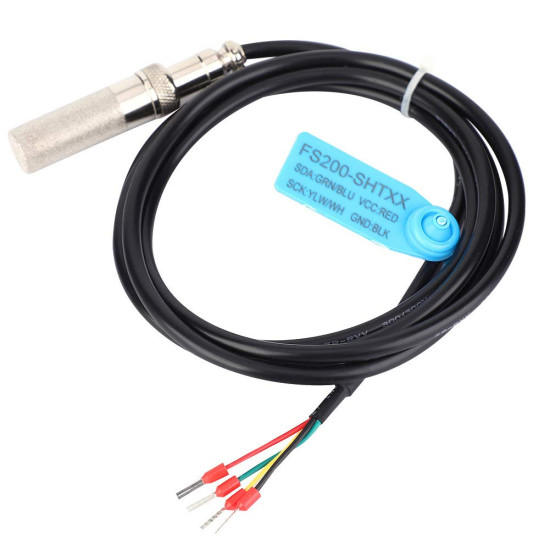
The sensor probe is supplied with a pre-stripped, color-coded 4-wire high-flex cable designed for straightforward integration into custom circuit boards, terminal blocks, or field-deployment junction boxes. The pinout assignments and line functions are defined as follows:

Red Wire - VCC (Power Supply Positive): Accepts a regulated DC supply voltage ranging from 3.3V to 5.5V. Connect to the logic level voltage source corresponding to your master MCU or system rail. Decoupling with a 0.1uF ceramic capacitor placed near the host system connection is recommended to suppress power line noise.

Black Wire - GND (System Power and Signal Ground): Common reference point for power and digital logic levels. Must be connected to the ground plane of the microcontroller or host acquisition board.

Yellow Wire - DATA / SDA (I2C Serial Data Line): Bi-directional serial data transmission line. Utilizes open-drain logic and requires an external pull-up resistor (typically 4.7k ohms to 10k ohms) tied to VCC on the host controller bus. Ensure trace length and cable capacitance are considered when selecting pull-up resistance.

White Wire - CLK / SCL (I2C Serial Clock Line): Master-driven clock synchronization input line. Standard logic operation requires an external pull-up resistor (typically 4.7k ohms to 10k ohms) tied to VCC on the host system board.

I2C Bus Communication and Software Implementation

The probe operates as a slave device on the standard I2C bus with a factory-set default 7-bit hardware address (typically 0x44 or 0x45 depending on internal silicon configuration). Standard communication sequence consists of a START condition, target slave address transmission, read/write command bits, measurement command bytes, CRC validation, and continuous polling response. Internal 16-bit cyclic redundancy check (CRC-8) calculations are generated automatically by the sensor core to guarantee packet integrity over extended industrial wiring.

When writing firmware routines, developers should issue single-shot or periodic measurement commands, followed by a non-blocking wait duration (typically 15 ms to 50 ms depending on selected sampling resolution) before reading the 6-byte data payload. The payload comprises 2 bytes for raw temperature data, 1 byte for temperature CRC, 2 bytes for raw relative humidity data, and 1 byte for humidity CRC. Raw 16-bit integers are converted to engineering units using simple conversion formulas implemented in standard platform libraries (Arduino, Python, ESP-IDF, Raspberry Pi Linux I2C sub-systems).

Application Use-Cases

1. Precision Agriculture and Automated Crop Monitoring

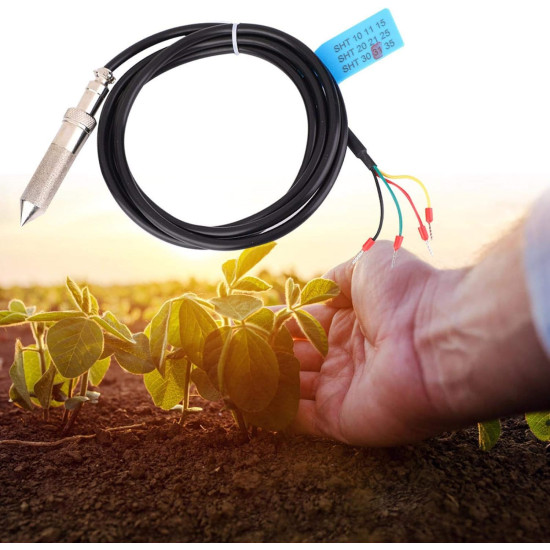
In modern high-density farming operations, monitoring root zone microclimates is critical for optimizing crop yield and preventing disease. Placing these I2C probes directly at various root depth strata provides precise sub-surface temperature and ambient substrate relative humidity measurements. Farmers can track soil warming profiles during early spring planting, forecast germination timing, and monitor thermal stress on crop roots during mid-summer heatwaves. The digital I2C signal avoids the sensor drift caused by ground potential drops, allowing reliable data acquisition across automated field sensor arrays.

2. Smart Irrigation Systems and Automated Valve Actuation

Integrating these humidity and temperature probes into automated irrigation control networks prevents over-watering and reduces overall water usage in drought-prone regions. By continuously assessing root-zone moisture evaporation dynamics and relative soil air volume humidity, closed-loop PLC controllers can trigger solenoid valves only when micro-environmental thresholds fall below critical wilting points. The fast sensor response time allows realtime feedback during drip irrigation cycles, conserving resources and avoiding nutrient leaching caused by over-saturation.

3. Commercial Greenhouse Climate Optimization

Commercial greenhouses require rigid atmospheric and growing-medium monitoring to maintain optimal vapor pressure deficit (VPD) levels. The probe can be embedded directly into coconut coir, rockwool, or rich soil beds to verify root zone microclimates alongside ambient air sensors. Standardized I2C networking allows microcontrollers like ESP32 or STM32 to gather multi-zone environmental profiles and control root heating cables, fogging systems, and ventilation louvers to maintain perfect growing conditions year-round.

4. Soil Science, Forestry, and Ecological Field Research

Ecologists and soil scientists require precise long-term baseline data to study soil carbon sequestration, microbial activity, and forest floor evaporation mechanics. The probe sintered metal housing protects internal elements from organic acids, micro-fauna, and root encroachment during multi-year field deployments. Connected to low-power cellular or LoRaWAN field loggers, the sensor operates reliably under snowpacks, heavy rain, and continuous ground saturation while capturing transient thermal and humidity fluctuations.

5. Green Roof and Urban Landscaping Maintenance

Urban green infrastructure, such as vegetated roofs and bio-swales, features engineered substrates that drain rapidly and experience extreme temperature variations. Installing this compact 120 mm probe in shallow green-roof planting media enables continuous health assessment of urban flora. System operators receive early warnings when shallow soil layers dry out, preventing plant mortality on building tops that are difficult to inspect manually.

6. Compost Process Monitoring and Thermal Optimization

Industrial composting operations rely on precise temperature and humidity balances to sustain thermophilic bacterial activity needed for organic decomposition. The durable probe housing tolerates harsh chemical bi-products such as mild ammonia gas and elevated humidity levels up to 100% RH. Operators can insert the sensor into compost windrows to track aerobic heating cycles, ensuring pathologically safe temperatures are reached while preventing material dry-out or anaerobic conditions.

7. Civil Engineering and Slope Stability Structural Health

Soil water content and ambient temperature strongly influence shear strength, freeze-thaw expansion, and thermal conductivity in civil engineering projects. Deploying these probes along earth retaining walls, embankment slopes, and under roadway foundations helps engineers track moisture migration patterns before structural shifting or frost heaves occur. The robust TPU cable jacket resists mechanical shear stresses during installation and long-term soil settlement.

8. Hydroponics Substrate and Soilless Media Profiling

Soilless culture mediums like perlite, vermiculite, and expanded clay aggregate demand precise moisture management due to low water holding capacity. Placing these sensors directly within growing slabs allows real-time determination of drying rates, permitting high-frequency, low-volume fertigation schedules. Digital calibration prevents offset errors common in analog sensors when high electrical conductivity (EC) fertilizer salts build up in hydroponic media.

Installation Best Practices and Field Deployment Guidelines

For optimum accuracy and service life, install the sensor probe in stable, representative soil volumes. Prepare a pilot hole using a auger or screwdriver slightly smaller than the 16 mm probe diameter to prevent air voids around the sintered cap. Gently insert the probe body vertically or at a 45-degree angle to prevent water from pooling directly along the cable entry point. Never hammer or force the sensor probe into hard, un-drilled ground, as high impact forces can fracture internal MEMS silicon structures or break the sintered housing interface.

Avoid placing the probe near high-voltage power lines, frequency inverters, or large electric motors to mitigate electromagnetic interference on the unshielded portion of signal wires. Ensure signal lines (SDA and SCL) are kept as short as possible, or use I2C bus extender ICs (such as PCA9600) for runs extending beyond 3 meters. Always include adequate strain relief on the UV-resistant cable near the surface level to prevent wind-driven plant motion or equipment from pulling on the embedded probe assembly.

Sensor Reliability, Drift Compensation, and Maintenance

The relative humidity reading generated by the internal sensor element relies on physical equilibration with the surrounding gas phase trapped within the sintered cap. Exposure to high relative humidity levels above 80% RH for extended periods may cause temporary signal drift of up to +3% RH. This is a reversible physical phenomenon inherent to capacitive polymer humidity sensors. Upon returning to normal dry ambient conditions, the sensor will naturally re-calibrate and recover to baseline accuracy without manual user intervention.

If the probe is deployed in soils treated with volatile organic solvents, heavy pesticides, or high concentrations of chemical fertilizers, clean the sintered outer cap periodically using distilled water or isopropyl alcohol solution. Allow the housing to dry completely before re-inserting into the substrate. Do not scrub the internal silicon component with wire brushes or sharp tools.

Package Contents

1 x High-Precision I2C Soil Temperature and Humidity Sensor Probe Assembly (150 cm cable)
1 x Cable Wire Marker and Identification Clip Set

Official Resources & Manuals

Ginō Ginō AI - Nerokas AI Assistant
✕
Jambo! I am Ginō, a Nerokas AI Assistant and Africa's best Open Hardware Facilitator AI agent here to help. In order to serve you better and to help me give you accurate shipping estimates as we begin, could you please tell me your name and your location/city?

You can also ask about any hardware or type I'd like to order, I am looking for..., you can also LIST all SKUs & Quantity of desired items from our website here for me to help you Checkout automatically at anytime to fast-track your requests and orders.