






















- Stock: Out Of Stock
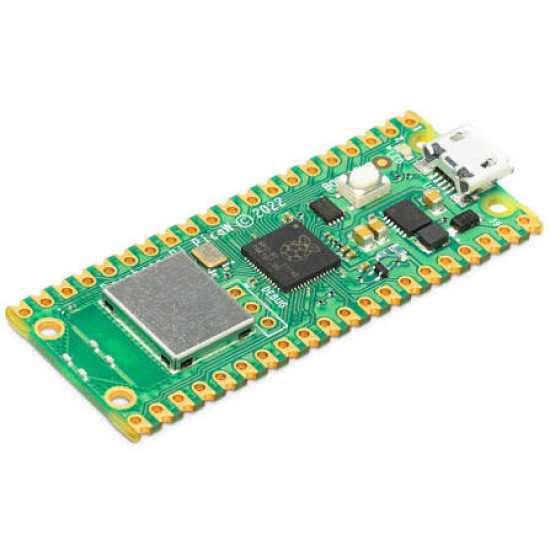
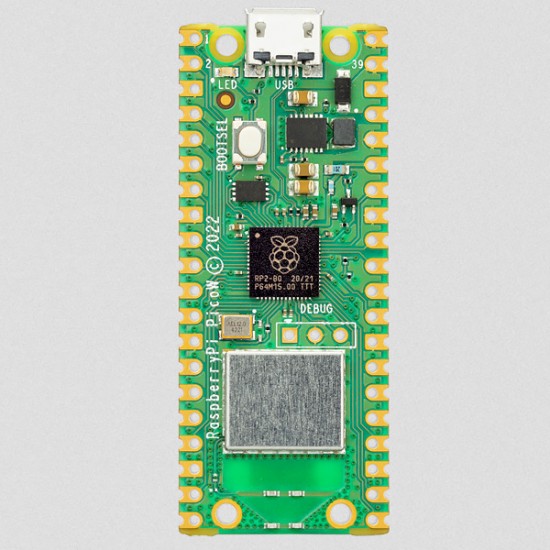
- Model: Raspberry Pi Pico W
- Weight: 3.00g
- Dimensions: 51.00mm x 21.00mm x 3.90mm
- SKU: 3793
Next-Generation Wireless Connectivity with Infineon CYW43439
The Raspberry Pi Pico W builds upon the remarkable cost-to-performance ratio of the original Pico board by incorporating high-performance wireless networking. Powered by an onboard Infineon CYW43439 wireless subsystem, the board supports 2.4 GHz IEEE 802.11b/g/n wireless LAN along with Bluetooth 5.2 capabilities. Featuring an onboard antenna developed by ABLS, the Pico W delivers reliable radio frequency performance for Internet of Things (IoT) nodes, telemetry collection, and remote embedded control systems without requiring external antenna hardware.
High-Performance Silicon Architecture Powered by RP2040
At the center of the Pico W design is the RP2040 microcontroller, engineered in-house by Raspberry Pi. The chip embeds twin 32-bit ARM Cortex-M0+ cores operating on a flexible clock up to 133 MHz. Memory assets include 264 KB of multi-bank SRAM and 2 MB of onboard QSPI flash memory for application code storage. A standout feature of the RP2040 is its dual Programmable I/O (PIO) blocks containing eight independent state machines. These allow deterministic execution of custom hardware communication protocols such as I2S, DPI, or custom serial streams without burdening the primary ARM cores.
Flexible Power Infrastructure and Intelligent Management
Engineered to excel in energy-sensitive and mobile environments, the Raspberry Pi Pico W utilizes a high-efficiency buck-boost switched-mode power supply (SMPS). Accepting a broad input voltage range from 1.8V to 5.5V, the system cleanly generates the required 3.3V operating rail. This wide input tolerance allows direct power operation from single-cell Lithium-Ion/Polymer batteries, three series AA cells, or regulated USB sources. Dynamic low-power execution modes including Sleep and Dormant reduce energy draw to microamps during idle periods.
Versatile Physical Form Factor and Multiplexed Hardware Interfaces
The Pico W offers 26 multifunction 3.3V GPIO pins exposed along castellated PCB edges. This dual-purpose design allows the board to accept standard 0.1-inch pin headers for prototyping on breadboards, or be reflow-soldered directly as a surface-mounted module onto custom PCB assemblies. Integrated hardware peripherals include two UART controllers, two SPI buses, two I2C controllers, 16 controllable PWM channels, and a 12-bit analog-to-digital converter (ADC) featuring three accessible external channels alongside an integrated temperature sensor.