



















- Stock: In Stock
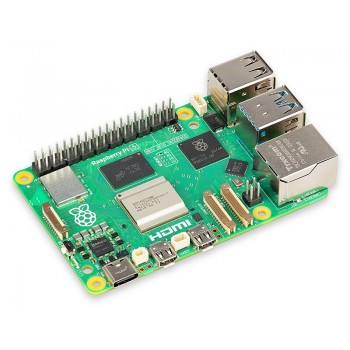
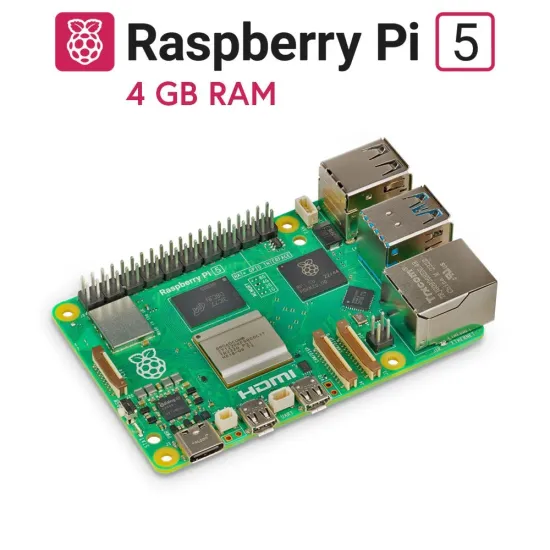
- Model: Raspberry Pi 5 Single Board Computer - 4GB
- SKU: 3876
Next-Generation Processing Architecture: Broadcom BCM2712 Silicon
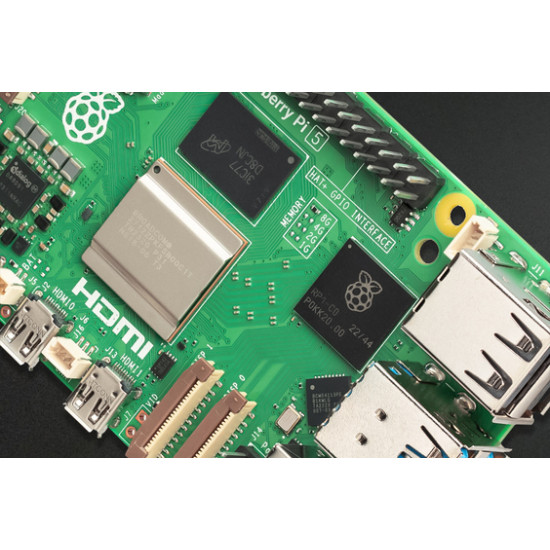
The Raspberry Pi 5 represents a monumental architectural leap forward in single-board computing, centered around the high-performance Broadcom BCM2712 system-on-chip. Built on a modern 16nm process node, this 64-bit quad-core Arm Cortex-A76 application processor operates at a nominal clock frequency of 2.4GHz. Architectural enhancements such as branch prediction improvements, wider execution pipelines, and cryptography extensions deliver a 2x to 3x uplift in raw CPU compute performance compared to the prior generation. Each core features 512KB of dedicated level 2 cache alongside a unified 2MB level 3 cache shared across the complex, significantly reducing memory latency during heavy multi-threaded execution. Memory bandwidth is drastically improved through the integration of high-speed LPDDR4X SDRAM running at 4267MT/s, enabling high-throughput execution of complex mathematical models, real-time edge analytics, containerized microservices, and local compilation tasks.
Proprietary RP1 Southbridge: Redefining I/O and Peripheral Throughput
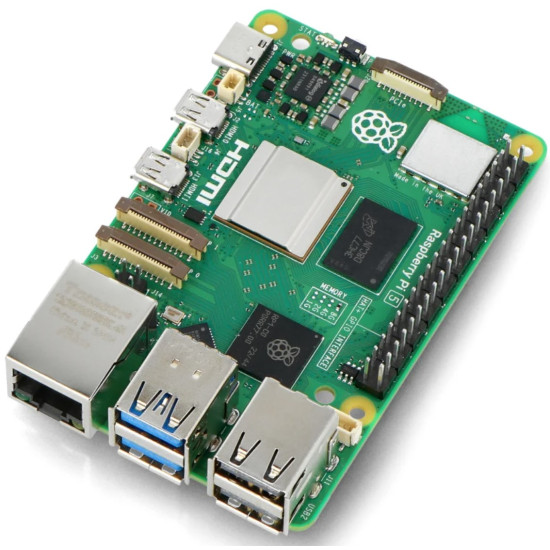
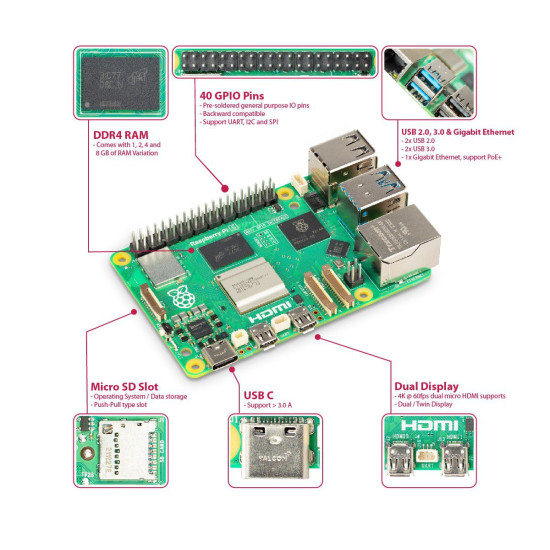
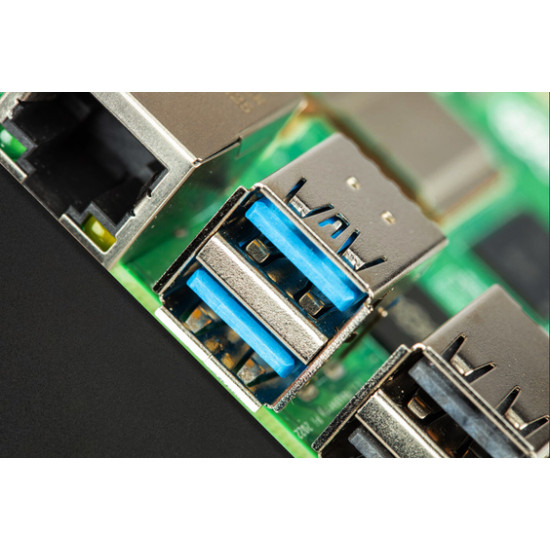
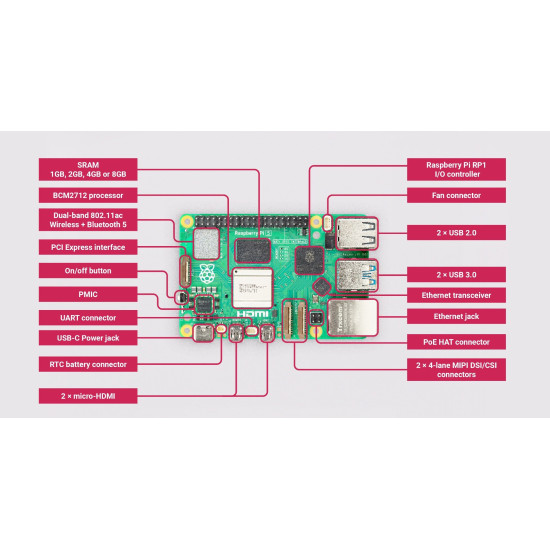
For the first time in a flagship single-board computer, Raspberry Pi incorporates custom in-house silicon designed specifically to decouple peripheral management from the main application processor. The RP1 southbridge connects to the BCM2712 SoC via a dedicated four-lane PCIe 2.0 bus, handling nearly all I/O capabilities. This architectural separation yields a major step-change improvement in peripheral bandwidth and overall system responsiveness. USB interface throughput is more than doubled, enabling simultaneous 5Gbps transfer rates across both USB 3.0 ports alongside independent USB 2.0 channels. In addition, the RP1 chip drives a redesigned camera and display subsystem, replacing fixed-function MIPI lanes with two versatile four-lane 1.5Gbps MIPI transceivers. These connectors support bidirectional assignment, allowing any arbitrary combination of two camera modules, two display screens, or one of each.
PCIe Expandability and High-Performance Connectivity
Engineered for high-throughput expandability and scalable hardware customization, the platform introduces an accessible single-lane PCIe 2.0 interface via a high-density FPC connector. This bus enables direct, low-latency interfacing with high-speed peripherals such as NVMe solid-state drives, artificial intelligence accelerators, and multi-gigabit network interfaces through external M.2 HAT adapter boards. SD card storage performance is elevated via support for the SDR104 high-speed transmission mode, doubling maximum theoretical read and write rates up to 104MB/s. Wireless communications encompass dual-band 802.11ac Wi-Fi operating on 2.4GHz and 5.0GHz bands, alongside Bluetooth 5.0 with Bluetooth Low Energy (BLE) support. Wired networking is managed by a dedicated Gigabit Ethernet PHY supporting Power over Ethernet (PoE+) functionality via a secondary power adapter board.
VideoCore VII Graphics, Multimedia, and Computational Vision
Graphics acceleration and hardware video decoding undergo a complete modernization driven by the integrated 800MHz VideoCore VII GPU. Modern graphics pipeline support includes full compliance with OpenGL ES 3.1 and Vulkan 1.3 specifications, offering enhanced tile-based rendering performance for interactive 3D applications, custom user interfaces, and embedded gaming platforms. Dual micro-HDMI ports provide independent video output up to 4Kp60 resolution with High Dynamic Range (HDR) color support. An integrated hardware-accelerated 4Kp60 HEVC/H.265 decoder unburdens the main CPU cores during heavy video playback and streaming duties. Furthermore, the updated hardware Image Signal Processor (ISP) within the RP1 silicon delivers advanced image reconstruction, real-time auto-exposure, computational photography routines, and direct camera sensor pipeline manipulation for industrial machine vision systems.
Industrial Reliability, Power Management, and Real-World Applications
Designed with industrial reliability, thermal efficiency, and developer workflow in mind, the platform integrates key board-level utility controls. These include a dedicated soft power button, an integrated Real-Time Clock (RTC) battery connector for offline timestamp accuracy, a dedicated 4-pin PWM fan header with tachometer feedback for intelligent active cooling control, and a pre-routed UART header for instantaneous low-level debugging. Power delivery is managed through a USB Type-C connector capable of negotiating 5V/5A operation via USB Power Delivery, ensuring sufficient current headroom for attached PCIe, USB, and GPIO expansion hardware. The Raspberry Pi 5 serves as an ideal hardware baseline for edge AI inference engines, industrial automation gateways, high-resolution digital signage installations, smart home server nodes, robotics platforms, and dual-monitor desktop workstation deployments.