























- Stock: In Stock
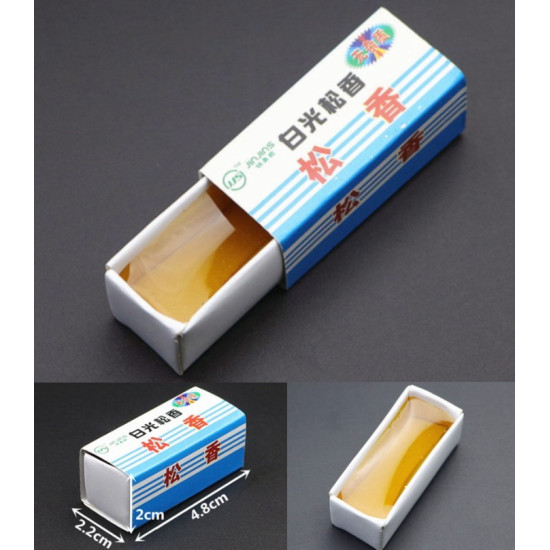
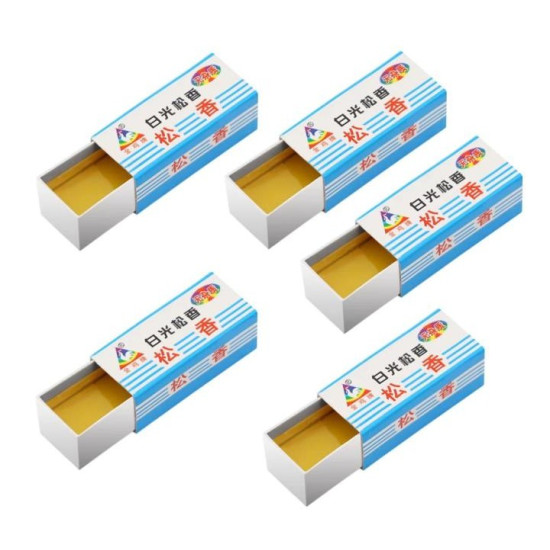
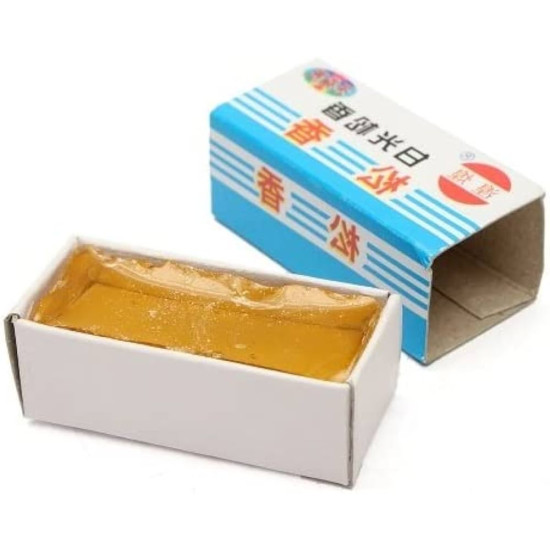
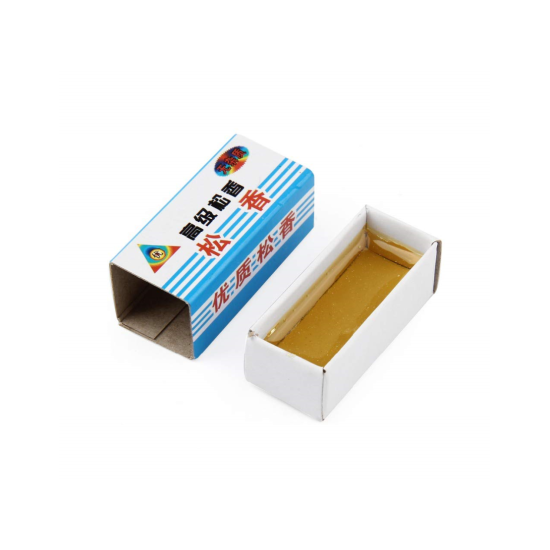
- Model: Rosin Soldering Flux Block
- Weight: 20.00
- Dimensions: 48.00 x 26.00 x 22.00
- SKU: 4103
Product Overview and Chemical Composition
Engineered from ultra-pure, refined Grade-WW natural pine resin, this high-grade solid rosin flux serves as an essential chemical activator for high-reliability electronic assembly and precision rework. Composed primarily of abietic acid and related isomeric resin acids, the solid flux undergoes thermal activation at standard soldering iron temperatures ranging from 250C to 380C. Upon contact with a heated tip, it rapidly liquefies into a low-viscosity fluid that aggressively dissolves native metallic oxides present on copper traces, component leads, and tin alloy substrates. This rapid oxide reduction establishes pristine, oxide-free metallic surfaces necessary for optimal fluid wetting and robust intermetallic compound formation.
Metallurgical Mechanics and Performance
During thermal application, this solid rosin significantly reduces the surface tension of molten solder alloys, including eutectic Sn63/Pb37 and SAC305 lead-free formulations. By enhancing fluid capillarity, the flux facilitates uniform solder flow into tight mechanical tolerances, prevents bridging between fine-pitch pads, and eliminates voiding and cold solder joints. The active resin acids undergo thermal decomposition during the soldering cycle, transitioning upon cooling into a hard, non-corrosive, glass-like residue. This inert matrix encapsulates potential ionic contaminants, delivering exceptional Surface Insulation Resistance across high-density circuit board layouts.
Key Applications and Industrial Use Cases
This solid rosin block is formulated for a wide array of precision electrical work and assembly environments. It is ideal for manual Surface Mount Technology rework, fine-pitch Surface Mount Device desoldering, Through-Hole Technology component soldering, heavy-gauge wire tinning, and high-reliability cable harness splicing. Furthermore, its ultra-low ionic activity makes it a preferred choice for vintage audio equipment restoration, RF module shielding, field repair kits, and specialized prototyping where high dielectric strength is required.
Operational Guidelines and Environmental Handling
To apply, dip the hot soldering iron tip directly into the solid rosin block or pass the solder wire over the rosin surface prior to heating the target joint. Thermal activation occurs instantaneously, spreading a protective blanket over the joint area to prevent re-oxidation during molten alloy delivery. Although the post-soldering residue is non-conductive and non-corrosive, it can be easily cleaned using standard isopropyl alcohol or specialized flux remover if high-reliability conformal coating or visual inspection is required. Store in its sealed container below 30C to maintain structural density and chemical performance.