



















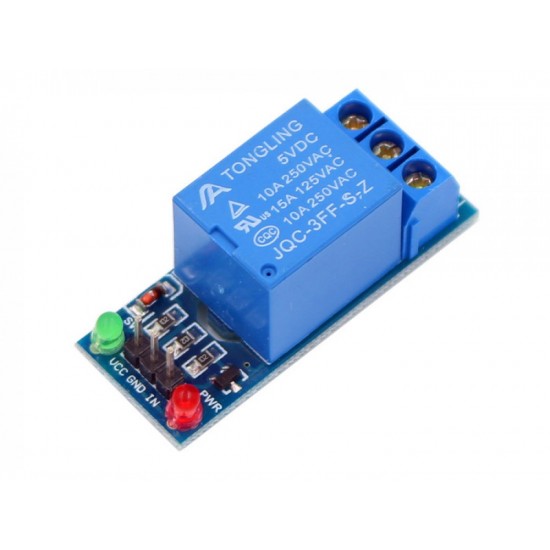
- Stock: Out Of Stock
- Model: 5V 1 Channel Relay Module
- Weight: 16.50g
- Dimensions: 43.00mm x 26.00mm x 18.50mm
- SKU: 66
High-Power Load Switching for Microcontrollers
The 5V Single-Channel Relay Module serves as an essential bridge between low-voltage digital control logic and high-power electrical loads. Designed specifically for seamless integration with microcontrollers such as Arduino, Raspberry Pi, ESP8266, and STM32, this module allows digital output pins to switch AC mains or high-current DC devices cleanly and safely. Operating on a 5V DC control voltage, the module utilizes an active-HIGH trigger logic where setting the control pin to a digital HIGH state energizes the internal electromagnetic coil, pulling in the armature to close the Normally Open (NO) contacts and allow load current to flow.
Robust Circuitry and Visual Status
To ensure system stability and real-time operational feedback, the board includes an integrated status LED indicator that lights up whenever the relay coil is energized. The module contains onboard transistor driver circuitry that allows microcontrollers to drive the relay coil using standard low-current GPIO output, preventing excessive current draw from sensitive digital logic ICs. Built-in flyback diode protection suppresses inductive voltage spikes produced when the relay coil de-energizes, protecting upstream control circuitry from transient damage.
High-Voltage and High-Current Specifications
Equipped with heavy-duty electromechanical contacts, this single-channel relay handles switching loads of up to 10A at 250VAC or 10A at 30VDC. With both Normally Open (NO) and Normally Closed (NC) screw terminal outputs available alongside the Common (COM) terminal, users can configure the module for various circuit topologies, including fail-safe or toggled switching networks.
Versatile Application Use-Cases
This module is ideal for home automation systems, industrial automation, smart energy management, and robotics projects. Common application examples include controlling AC lighting fixtures, managing solenoid valves, driving DC motors, regulating heating elements, and switching external power supplies via microcontrollers or sensor logic.