Menu
Your Cart
NOTICE: We have Fully discontinued physical walk-in customer service, RFQ, and LPO processing. Nerokas is now a FULLY DIGITAL ONLINE STORE, and our virtual assistant, Ginō AI, is here to help you navigate and checkout. Just ADD your Items to cart and type CHECKOUT on Ginō. Please note that corporate customers must register a corporate account to ensure proper Digital eTIMS/VAT processing.

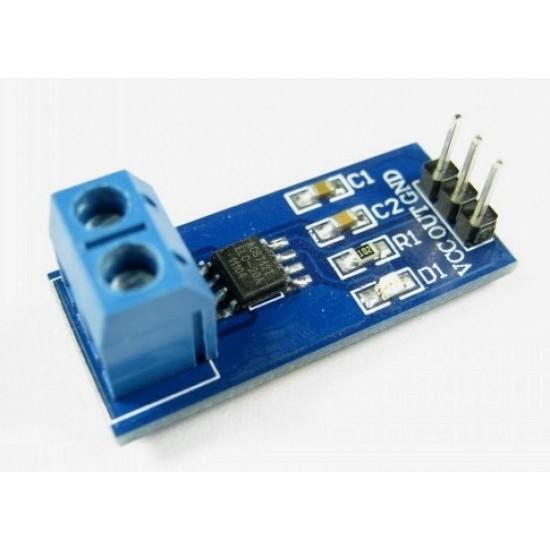
Current Sensor Module ACS712 30A

Current Sensor Module ACS712 30A
KES 600.00
  • Stock: In Stock
  • Model: ACS712
  • Weight: 4.80g
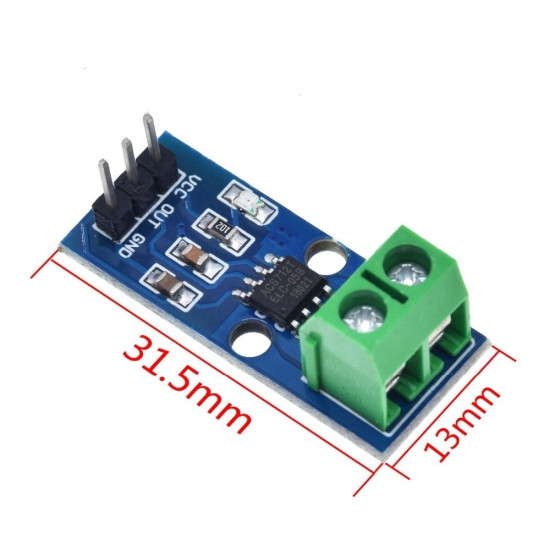
  • Dimensions: 31.20mm x 13.10mm x 14.00mm
  • SKU: 919

Overview and Operating Principle

The ACS712 30A Hall-Effect Current Sensor Module provides an accurate, economical solution for both AC and DC current sensing in industrial, commercial, and communications systems. The device consists of a precise, low-offset, linear Hall circuit with a copper conduction path located near the surface of the die. Applied current flowing through this copper conduction path generates a localized magnetic field which the integrated Hall IC converts into a proportional analog output voltage.

Device accuracy is optimized through the close proximity of the magnetic signal to the Hall transducer. A precise, proportional voltage is provided by the low-offset, ratiometric CMOS Hall IC, which is programmed for accuracy at the factory. The internal resistance of this conductive path is typically 1.2 mOhm, providing low power loss and minimal thermal dissipation during high-current operation. Furthermore, the terminals of the conductive path are electrically isolated from the sensor leads (pins 5 through 8). This allows the ACS712 current sensor module to be used in applications requiring electrical isolation without the use of opto-isolators or other costly isolation techniques.

Terminal Pinout and Connection Architecture

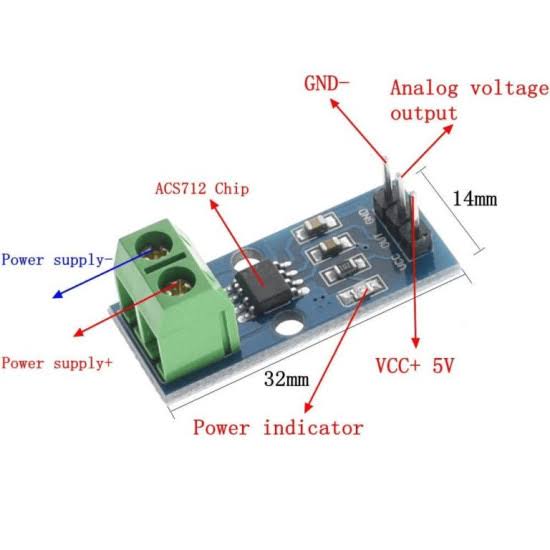
The module breaks out the SOIC-8 package pins into user-friendly screw terminals and standard 0.1 inch headers for easy prototyping and system integration.

High-Current Terminal Block (AC/DC Current Path):

IP+ Terminal: Positive input terminal for the current path being measured. The conductor carries the load current directly into the internal 1.2 mOhm copper trace. Designed to accept heavy gauge wire up to 14 AWG.

IP- Terminal: Negative output terminal for the current path being measured. Completes the high-current inline circuit to the load. Because the sensing circuit operates on magnetic flux detection, current flowing from IP+ to IP- produces an output voltage increase above the zero-current offset reference voltage.

Low-Voltage Logic and Signal Interface Header:

VCC Pin: Power supply input terminal. Requires a clean 5.0 V DC power supply. The internal Hall IC relies on a stable 5V rail as its ratiometric output scales directly with VCC variations.

GND Pin: System ground connection pin. Must share a common ground reference with the host microcontroller or analog-to-digital converter (ADC).

OUT Pin: Analog output signal pin. Outputs an analog voltage proportional to the current passing through the IP+ and IP- terminals. When zero current is flowing through the sensing terminals, the output voltage rests at VCC / 2 (normally 2.5V DC for a 5.0V supply). Current flowing from IP+ to IP- increases the voltage, while reverse current flow decreases the voltage.

FILTER Pin / Bypass Capacitor Connection: On-board filtering terminal connected to pin 6 of the integrated circuit. Adding an external capacitor across this node to ground sets the device bandwidth and attenuates high-frequency noise without compromising measurement integrity.

Precision Signal Conditioning and Mathematics

The ACS712 30A variant features an output sensitivity of 66 mV per Ampere (mV/A) centered around a zero-current reference of VCC / 2 (2.5V). When reading DC current, the equation to determine sensed load current (I) from output voltage (Vout) is calculated as: I = (Vout - 2.5V) / 0.066 V/A. For alternating current (AC) measurement, the output exhibits a sinusoidal waveform centered around 2.5V. To accurately calculate AC current, a high-speed ADC must sample the waveform over several full cycles to calculate the Root Mean Square (RMS) voltage, which is then divided by the 66 mV/A sensitivity factor.

The integrated low-noise analog signal path enables high-speed signal processing with an internal bandwidth of 80 kHz. Response time to step input current is roughly 5 microseconds, making this module suitable for quick fault protection and fast overcurrent shutdown applications.

Microcontroller Interfacing and Signal Processing

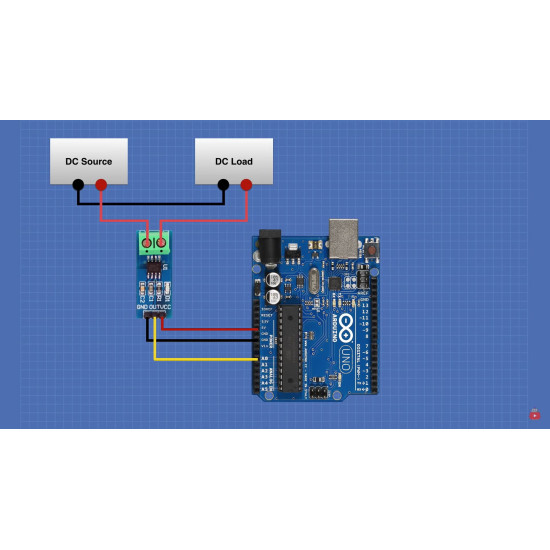
Interfacing the ACS712 with 5V microcontrollers such as Arduino UNO or ATmega328P is straightforward using the built-in 10-bit analog-to-digital converter. Each LSB step represents approximately 4.88 mV (5V / 1024), translating to a resolution of roughly 74 mA per ADC step on the 30A model.

When interfacing with 3.3V microcontrollers such as ESP32, STM32, or Raspberry Pi Pico, voltage attenuation must be implemented on the OUT signal line. Because the sensor output can reach up to 4.5V under maximum positive load current, a resistive voltage divider or operational amplifier buffer/attenuator circuit must be inserted between the sensor OUT pin and the 3.3V ADC pin to prevent overvoltage damage to the host MCU.

Practical Application Use-Cases

1. Solar PV Inverter and Charge Controller Energy Tracking: In off-grid and grid-tied photovoltaic systems, tracking charge and discharge current is vital for calculating battery State of Charge (SoC). Positioned inline between solar panels and MPPT controllers, the ACS712 measures bidirectional current to assist in real-time solar yield optimization and power metering.

2. AC Motor Overcurrent and Stall Protection: Electric motors in conveyor belts, CNC equipment, and pumps experience high current surges when stalled or mechanically overloaded. Placing the ACS712 in series with one of the AC mains power phases allows a microcontroller to continuously monitor current consumption and trigger a safety relay if current exceeds pre-configured safety thresholds for longer than a specified duration.

3. Smart Home Energy Metering and Load Monitoring: Embedded into smart switchboards or intelligent wall sockets, the ACS712 continuously samples AC line current supplied to home appliances. By integrating voltage and current measurements over time, energy management systems can compute true real power (Watts), power factor, and total kilowatt-hour (kWh) consumption.

4. Uninterruptible Power Supply (UPS) Battery Monitoring: In backup power systems, real-time monitoring of lead-acid or lithium battery discharge rates ensures system longevity and safe operational margins. The ACS712 provides continuous feedback to the UPS control logic to calculate runtime capacity remaining during power outages.

5. Industrial Pump and Compressor Condition Diagnostics: Mechanical degradation in industrial compressors and water pumps often manifests as elevated current consumption before complete system failure occurs. Installing the ACS712 in industrial predictive maintenance monitoring nodes enables early detection of mechanical wear, bearing friction, and line blockages.

6. Electric Vehicle (EV) Battery Management Systems (BMS): High-power battery packs in light electric vehicles, golf carts, and robotics require accurate current tracking during acceleration and regenerative braking cycles. The ACS712 provides clean analog signals to BMS boards to prevent cell over-discharge and thermal runaway events.

7. Switched-Mode Power Supply (SMPS) Feedback Loops: Modern power supplies require accurate dynamic current feedback to maintain voltage regulation and protect internal switching MOSFETs from short-circuit conditions. The high-speed 80 kHz bandwidth and low rise time of the ACS712 enable rapid shutdown control signals during output short-circuits.

8. Automated Resistance Spot Welding Current Verification: Precision industrial spot welding relies on tight pulse duration and stable current levels to form consistent welds. The ACS712 measures secondary output pulses in low-to-medium power automated welders, sending empirical telemetry back to quality control loggers.

Galvanic Isolation, Isolation Creepage, and Safety

The ACS712 internal conductor pins (1 through 4) are completely isolated from the sensor IC leads (pins 5 through 8). The device provides a minimum 2.1 kVRMS isolation rating. This safety barrier allows low-voltage microcontrollers operating on 5V logic to safely sample high-voltage mains electricity up to 230V AC without ground loop hazards or destruction of the control board. Proper creepage and clearance distances must be maintained on the user custom PCB layout surrounding the primary high-voltage screw terminals.

Ginō Ginō AI - Nerokas AI Assistant
✕
Jambo! I am Ginō, a Nerokas AI Assistant and Africa's best Open Hardware Facilitator AI agent here to help. In order to serve you better and to help me give you accurate shipping estimates as we begin, could you please tell me your name and your location/city?

You can also ask about any hardware or type I'd like to order, I am looking for..., you can also LIST all SKUs & Quantity of desired items from our website here for me to help you Checkout automatically at anytime to fast-track your requests and orders.