




















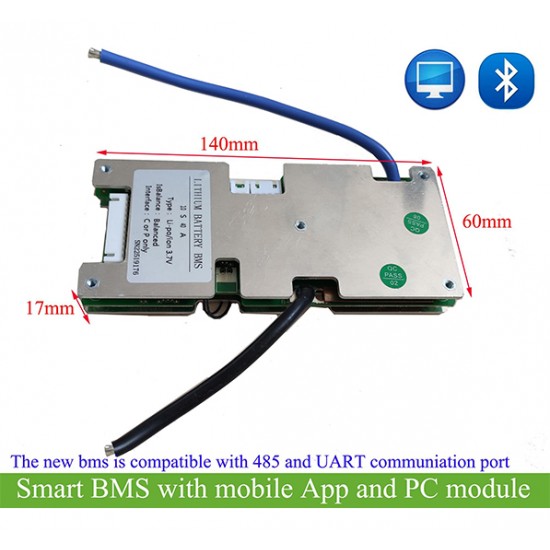
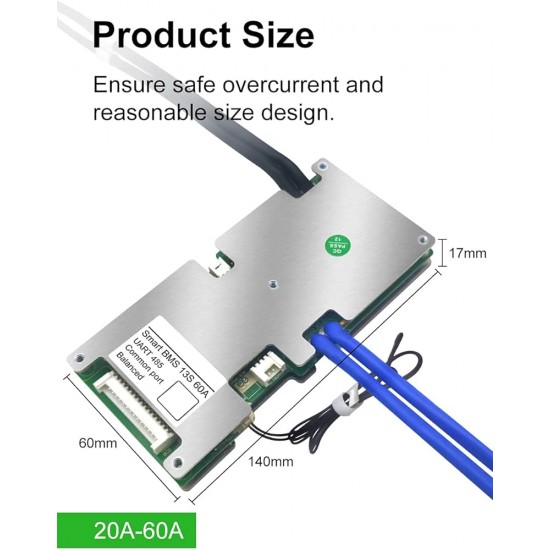


- Stock: In Stock
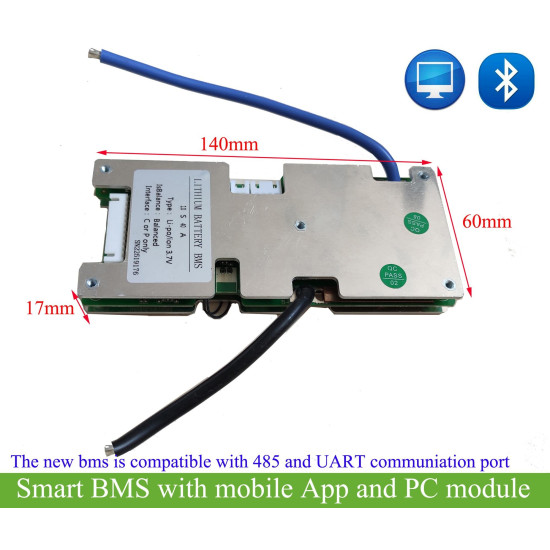
- Model: Smart BMS 7S 50A UART RS485
- SKU: 3725
Advanced Battery Monitoring and Programmable Control
This programmable Smart BMS (Battery Management System) provides real-time telemetric monitoring and precision protection for high-performance battery packs. Compatible with Lithium-ion (6S, 7S, and 10S cell series) and Lithium Iron Phosphate (8S LiFePO4) chemistries, this protection board allows end users and system integrators to fine-tune overvoltage, undervoltage, cell balancing, and temperature threshold limits using mobile or desktop software applications.
Multi-Protocol Connectivity and Telemetry Interface
Equipped with dedicated UART and RS485 communication interfaces alongside an included wireless Bluetooth transceiver module, this management system provides full visibility into battery pack operational status. Users can monitor individual cell voltages, current differential, instantaneous power output, cumulative charge cycles, and total pack capacity calculated using a precise Coulomb-meter algorithm. Built-in Hall sensor pulse input support enables real-time speed monitoring and remaining distance estimation for light electric vehicles.
Dual Hardware and Software Protection Architecture
Designed with imported control ICs, the circuit utilizes a dual-layer safety architecture combining instant hardware interrupt protection with continuous software runtime verification. Integrated dynamic temperature sensors monitor internal power balance heat and ambient battery thermal conditions, safely cutting off power during extreme over-temperature (75 degrees C) or under-temperature (-10 degrees C) events. High-precision passive balancing delivers 50-60mA of equalization current across cell groups to prolong pack life.
High Efficiency and Application Adaptability
Featuring active operating current consumption under 40uA and sleep consumption under 30uA, the protection board prevents deep discharge during extended storage periods. The board supports discharge currents up to 50A and charging currents up to 40A, making it ideal for electric mobility, solar storage setups, portable power banks, and industrial battery packs. All connected battery cells should maintain consistent specifications (voltage difference less than 0.05V, internal resistance variance under 5 milli-ohms) for maximum system reliability.