- Stock: In Stock
- Model: 21-cell 18650 battery box
- SKU: 3797
Build Your Own Powerful 12V Power
Source with the 18650 Battery Box DIY Kit!
Are you ready for the challenge or move beyond basic soldering and create something truly useful? Start building your own 12V power system today! This DIY kit gives you the essential housing and electronics to assemble a custom 12V lithium-ion battery pack. It's the perfect next-step project for hobbyists, DIY enthusiasts, and makers who want to build their own portable power solutions.
Whether
you need a reliable backup power supply (UPS) for your devices, a custom
battery for an E-bike, or a portable power pack for your electronic projects,
this kit provides the foundation. By assembling it yourself, you gain
invaluable insight into battery management systems (BMS), series connections,
and safe battery pack construction.
10
Powerful Applications for Your 12V DIY Battery Box
Once
you've safely assembled your 21-cell 18650 battery pack using this kit, you
unlock a world of portable and backup power solutions. Here are 10 detailed
ways to put your custom 12V power source to work.
1.
Custom E-Bike or E-Scooter Power Pack
·
Replace an aging or underperforming battery on an electric bicycle or scooter.
The compact 150x65x94mm form factor is ideal for mounting on a frame rack or
hiding in a case. The 3S 40A BMS is perfectly rated to handle the high current
draw of a 250W-500W hub motor. With 21 high-drain 18650 cells (like the 10C
ones recommended), you get a balance of decent range and the ability to deliver
bursts of power for hills and acceleration.
2.
Heavy-Duty Portable Power Station for Camping/Outdoors
·
Build the core of a camping power supply. Combine this battery box with a 12V
socket panel, USB chargers, and even a small inverter inside a weatherproof
case. The 12V output directly powers camping fridges, 12V LED lighting strips,
and fans for hours. You're creating a custom "solar generator" core

at a fraction of the cost of pre-built units, and you can repair it yourself.
3.
Uninterruptible Power Supply (UPS) for Networking Gear
·
Keep your Wi-Fi router, modem, and network switch running during a power
outage. Most home networking gear runs on 9V-12V DC. You can wire the battery
output to a DC barrel jack splitter, feeding power to your devices. When the

mains power goes out, your internet connection stays alive, keeping you
connected for work or communication.

4.
High-Capacity Power Source for Robotics Projects
·
Move beyond small battery packs and power a serious robotics platform, such as
an Arduino robot arm, a combat robot, or an autonomous lawnmower. The 40A
continuous discharge capability provides clean, stable power to multiple
high-torque motors, servo controllers, and a main computer (like a Raspberry Pi
or Arduino) simultaneously, without voltage sag.
5.
Portable 12V Sound System / Boombox Power
·
Build a "party pack" for a portable Bluetooth speaker or a set of
powered PA speakers for outdoor events. Car audio amplifiers and many
high-power portable speakers run on 12V. This battery pack provides the
sustained, quiet power needed for hours of music playback, far outlasting any
D-cell battery solution.
6.
Field Power Supply for RC Hobbyists (Charging Station)
·
Create a re-chargeable field box to recharge your LiPo (Lithium Polymer)
batteries for drones, RC cars, and planes while at the park or flying field.
Instead of relying on a friend's car battery, you can connect this 12V pack to
your RC battery charger. The high capacity lets you recharge multiple flight
packs, extending your fun time significantly.
7. Off-Grid Lighting System for Shed, Garage, or Workshop
·
Set up a dedicated, always-ready lighting system for a location without mains
power. Wire the battery box to a simple switch and 12V LED light strips. It's
perfect for a garden shed, a workshop corner, or even a chicken coop, providing
reliable light without running extension cords. You can recharge it via a small
solar panel.
8.
Portable Power for Carp Fishing or Camping Electronics
·
Power essential gear like bite alarms, illuminated floats, phone charging, and
a small 12V TV or monitor for a comfortable night session. Specialist portable
power units are expensive. This DIY pack offers a high-capacity, quiet, and
fume-free alternative to a small petrol generator for powering sensitive
electronics all night long.
9.
Backup Power for Medical or CPAP Machine
·
Provide emergency power for a CPAP machine or other essential 12V medical
device during a power outage. For peace of mind, having a dedicated, fully
charged 12V battery pack ensures you can continue using critical equipment
overnight. (Crucial Safety
Note: Ensure the device is compatible with a non-regulated battery output and
test the setup thoroughly before relying on it in an emergency.)
10.
Solar-Powered Battery Bank for Remote Monitoring
·
Build a self-sufficient power supply for a remote weather station, wildlife
camera, or security camera. By connecting a small solar charge controller
between a solar panel and this battery box, you create a system that charges
during the day and powers equipment 24/7. The robust 18650 cells handle daily
charge/discharge cycles better than lead-acid batteries in this
"cyclic" use case.
Please Note: This kit includes the box, BMS, and cell holder
only. You will need to purchase 3.7V 18650 lithium-ion batteries separately to
complete the project.
What's
in the Box?
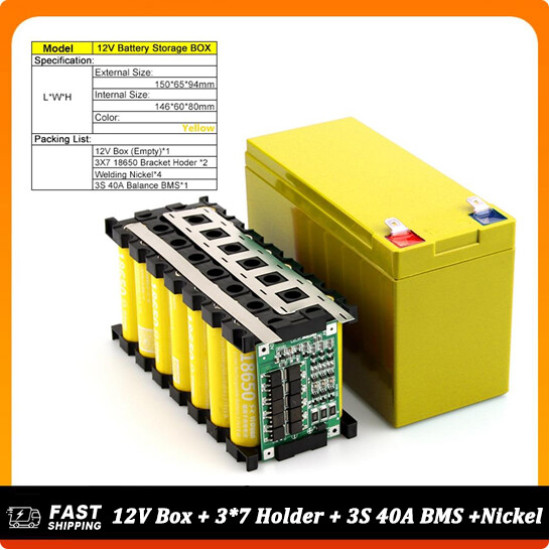
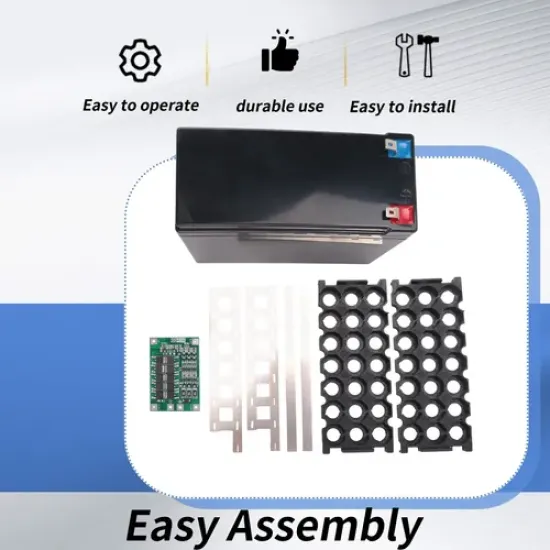
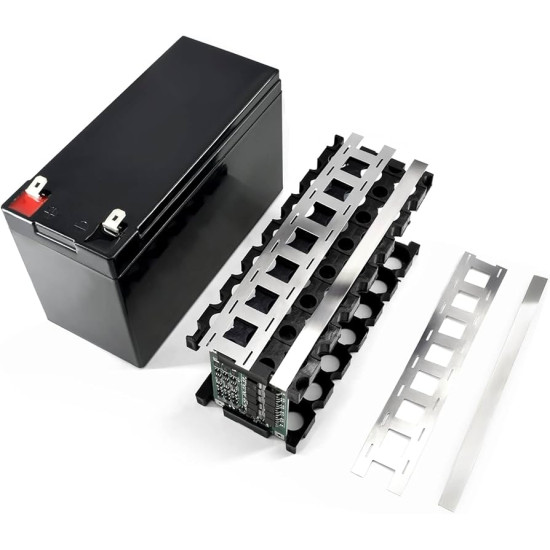
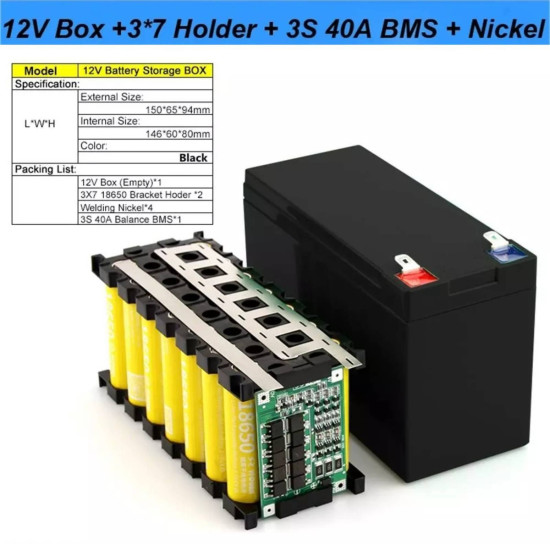
- Durable ABS Plastic Battery Box: - A sturdy, lightweight enclosure to safely house your cells.
- Dimensions: 150mm x 65mm x 94mm.
- Color Options: Black.
- 3S 40A Balance BMS (Battery Management System): - The brain of your battery pack. This critical electronic board protects your cells from over-charge, over-discharge, over-current, and short circuits, while also balancing the voltage across all cells for optimal performance and longevity. (Essential for safe operation!)
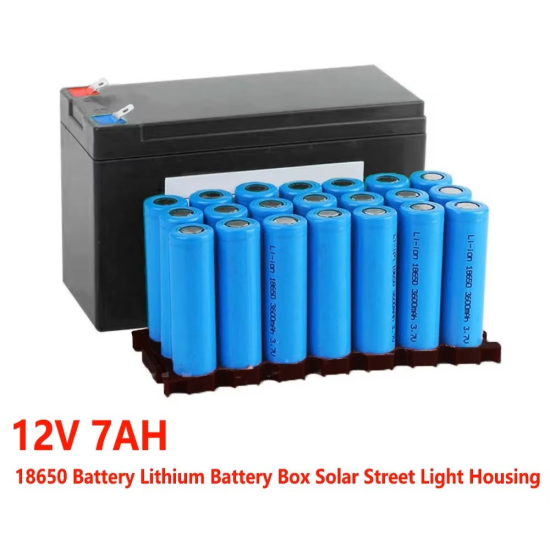
- 21-Cell Battery Holder: A precisely spaced holder to securely organize 21 x 18650 cells in a 3S7P configuration (3 series groups of 7 parallel cells)
- Nickel Strips: High-purity nickel strips for making reliable, low-resistance connections between the cells and to the BMS, using spot welding (recommended) or careful soldering.
What
You'll Need (Not Included)
To
complete your 12V battery pack, you will need:
· 21 x 18650 Lithium-Ion Batteries: This project requires unprotected, flat-top 18650 cells. We recommend high-quality cells like the ones available here: Purchase 18650 Batteries here. Please read the safety notice on that page carefully.
·
Spot
Welder (Highly Recommended): The safest and most reliable way to attach nickel
strips to battery terminals.
·
Soldering
Iron & Wire:
For connecting the BMS wires to the nickel strips and assembling the final
output leads.
·
Wire
Cutters/Strippers & Multimeter: Essential tools for assembly and testing.
·
Personal
Safety Gear: Safety glasses and
insulated gloves are a must.
⚠️
CRITICAL SAFETY WARNING: LITHIUM-ION BATTERY HAZARDS
Lithium-ion
batteries (Li-ion) are incredibly powerful but can be extremely dangerous if
mishandled, damaged, or assembled incorrectly. They store a massive amount of
energy and can cause fires, explosions, and serious injury, if short-circuited,
overcharged, or physically damaged. PLEASE READ
AND UNDERSTAND ALL SAFETY PRECAUTIONS BEFORE YOU BEGIN.
General Safety
Rules.
·
Never leave
a lithium-ion battery pack unattended while charging or discharging.
·
Always
work in a well-ventilated area, away from flammable
materials (like paper, gasoline, or cloth).
·
Keep
a Class D fire extinguisher (for metal fires) or a large bucket of dry sand
nearby. NEVER use water on a lithium-ion battery fire.
·
Always
wear safety glasses and insulated gloves while handling cells and assembling
the pack.
Specific
Precautions for This DIY Kit:
1. Correct Cell Type
is Mandatory: This kit is designed for unprotected 3.7V 18650 Li-ion
cells. Do NOT use
LiFePO4 batteries,
as the BMS is not compatible. Do NOT use protected cells, as they are longer
and will not fit in the holder. Using incorrect cells can lead to BMS failure
and catastrophic battery failure.
2. Cell Quality & Matching is Critical:
·
Only
use new, high-quality cells from a reputable source (like the one linked). Used
or damaged cells of unknown history have unstable internal chemistry.
·
All
21 cells must be identical (same brand, model, capacity, and age). Mixing
different cells will cause imbalances that the BMS cannot correct, leading to
overheating and failure.
·
Check
every cell's voltage with a multimeter before assembly. They should all be at a
similar voltage (e.g., between 3.5V and 3.7V).
3. Assembly Dangers:
·
Absolute Short Circuit Prevention: The nickel strips and battery
terminals are live. A single misplaced strip or a dropped tool can create a
dead short, releasing immense heat instantly and causing an explosion. Work
slowly, deliberately, and use electrical tape to insulate exposed sections as
you go.
·
Spot Weld, Don't Solder (Ideally): Heating
the terminal of a lithium-ion cell by direct soldering can damage its internal
safety vent and separator, leading to internal short circuits and failure. A
spot welder is the safest method. If you must solder, be extremely fast (under
2 seconds per joint) and ensure the cell does not get hot.
·
Proper
Insulation: Once assembled, ensure all BMS connections and nickel strip ends
are securely insulated and cannot shift inside the case to cause a short.
4. First Use & Charging:
·
After
assembly, double-check all wiring against the BMS diagram twice. Have a
knowledgeable friend review it if possible.
·
Make
your first charge in a safe, outdoor area, away from buildings, and monitor the
pack constantly for at least the first full cycle. Feel for any unusual heat
from the cells or BMS.
·
Use
a compatible, high-quality 12.6V Li-ion charger. A cheap or incorrect charger
can overcharge the pack and cause a fire.
Remember: By assembling this kit, you are taking full
responsibility for your safety and the proper construction of the battery pack.
If you are uncomfortable with any of the steps or risks, seek guidance from an
experienced builder. Your safety is paramount.
Challenge yourself; Build Your Custom Power Solution Today!