Menu
Your Cart
NOTICE: We have Fully discontinued physical walk-in customer service, RFQ, and LPO processing. Nerokas is now a FULLY DIGITAL ONLINE STORE, and our virtual assistant, Ginō AI, is here to help you navigate and checkout. Just ADD your Items to cart and type CHECKOUT on Ginō. Please note that corporate customers must register a corporate account to ensure proper Digital eTIMS/VAT processing.

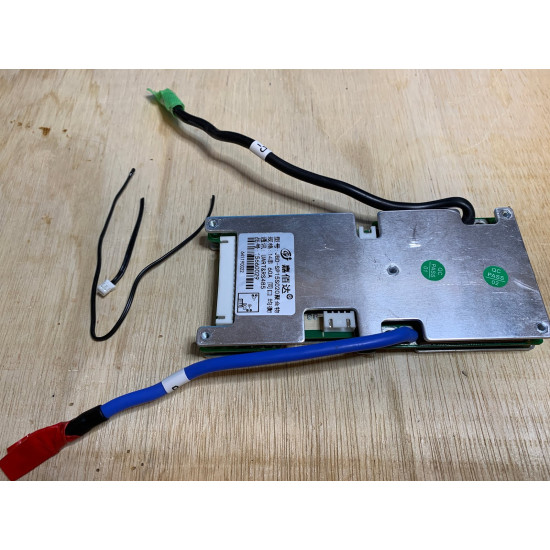
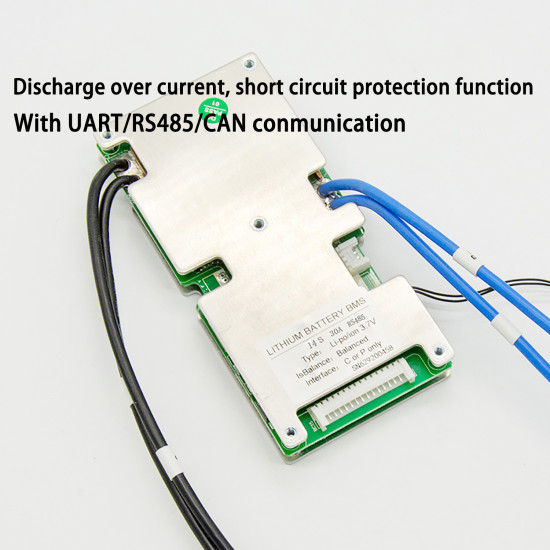
JBD SP15S020A V1.1 7S 50A Smart BMS with Bluetooth, UART, RS485

JBD SP15S020A V1.1 7S 50A Smart BMS with Bluetooth, UART, RS485
New
JBD SP15S020A V1.1 7S 50A Smart BMS with Bluetooth, UART, RS485
KES 10,500.00
  • Stock: In Stock
  • Model: JBD SP15S020A V1.1 50A Smart B
  • Weight: 75.00
  • Dimensions: 63.00 x 52.00 x 12.00
  • SKU: 386

Product Overview and Architecture

The JBD SP15S020A V1.1 is an industrial-grade, intelligent battery management system engineered for high-reliability energy storage and light electric vehicle propulsion. Designed to supervise lithium-based chemistries with laboratory precision, the architecture integrates a high-performance analog front-end (AFE), redundant hardware protection comparators, and a powerful dedicated microcontroller. Operating as a common-port power distribution platform, the SP15S020A V1.1 supports a continuous discharge current of 50A and withstands short-duration transient surges up to 150A for a full 1000 milliseconds. Its low-impedance power MOSFET array minimizes thermal accumulation during prolonged heavy-load operation, while isolated logic rails ensure stable telemetry transmission under harsh electromagnetic conditions.

Supported Battery Chemistries and Cell String Flexibility

This BMS board natively manages 11S to 15S series configurations while supporting software and hardware strapping configurations down to 7S strings, making it a flexible platform for nominal 24V, 36V, and 48V energy architectures. The onboard firmware natively supports Lithium Iron Phosphate (LiFePO4 with a nominal voltage of 3.2V per cell) and Lithium Nickel Manganese Cobalt Oxide (NMC / Li-ion with a nominal voltage of 3.6V to 3.7V per cell). Voltage detection circuitry delivers a measurement resolution of 1 millivolt across a wide operating envelope of 1.2V to 4.5V per channel. Designers can independently calibrate over-voltage protection (OVP), over-voltage release, under-voltage protection (UVP), and under-voltage release thresholds via communication links to preserve battery health over thousands of duty cycles.

Power Stage Dynamics and Current Sense Topology

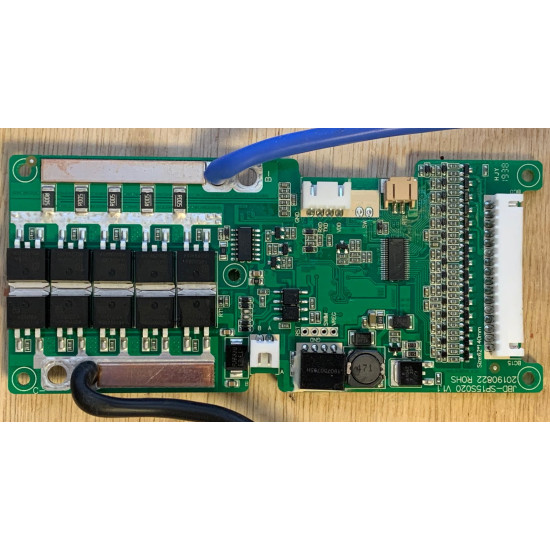
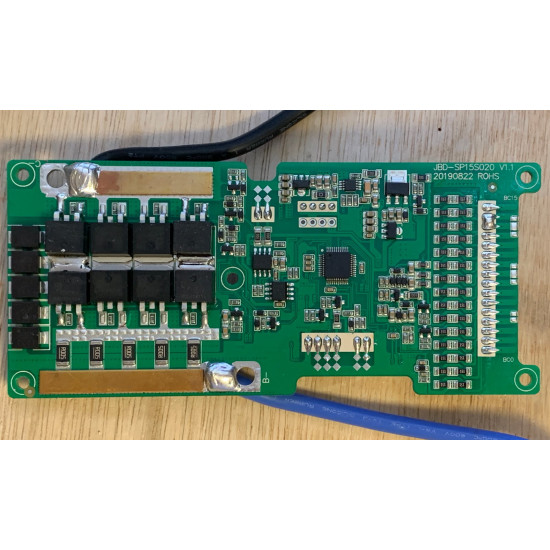
The high-current handling of the SP15S020A V1.1 relies on parallel high-side/low-side N-channel power MOSFET switching circuits anchored by heavy copper bus bars integrated directly into the printed circuit board substrate. Bidirectional current sensing is performed across precision, low-temperature-coefficient manganin shunt resistors, allowing the integrated coulomb counter to measure pack State of Charge (SOC) and State of Health (SOH) with exceptional precision. The hardware trip circuit features multi-tiered overcurrent stages, executing sub-millisecond interrupts during primary discharge overcurrent, secondary high-current fault events, and dead-short conditions where hardware gates clamp and shut down the switching array in less than 300 microseconds.

Integrated Communications: Bluetooth, UART, and RS485

Telemetry access is critical for mission-critical battery packs. The JBD SP15S020A V1.1 features an onboard Bluetooth Low Energy (BLE) transceiver module that broadcasts real-time operational parameters to iOS and Android applications. For automated systems, PLCs, and host microcontrollers, the board provides dedicated serial interfaces: a 3.3V TTL-level UART interface and an industrial multi-drop RS485 bus. Through these ports, engineers can read individual cell voltages, temperature sensor arrays, current flow, cycle counts, fault registers, and safety lockout statuses. Communication protocols conform to standard JBD register formats, permitting direct integration into proprietary SCADA, CAN/RS485 gateways, or custom embedded platforms.

Precision Cell Balancing and Thermal Protection

Cell divergence is countered via an onboard passive bleed balancing system. When cell voltages exceed the configured balance start voltage and an inter-cell differential threshold is crossed during charging, dedicated balancing resistors dissipate excessive energy via switched resistive shunt channels, delivering between 20mA and 55mA of balancing current per cell. Thermal safeguarding is managed symmetrically through a dual-sensor topology: an onboard surface-mount thermistor monitors the MOSFET junction temperatures, while an external precision NTC probe (10k ohm at 25 degrees C, B3950) is mechanically routed directly to the center core of the battery pack cells. Charge and discharge high/low temperature limits operate independently, eliminating thermal runaway threats while preventing low-temperature lithium plating during cold-weather charging.

Complete Wiring and Hardware Pinout Guide

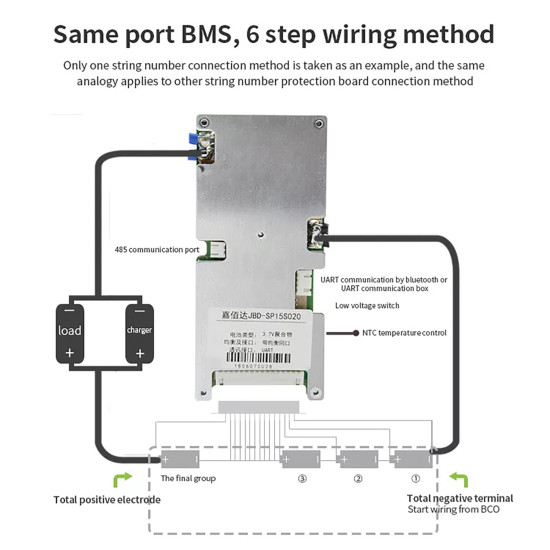
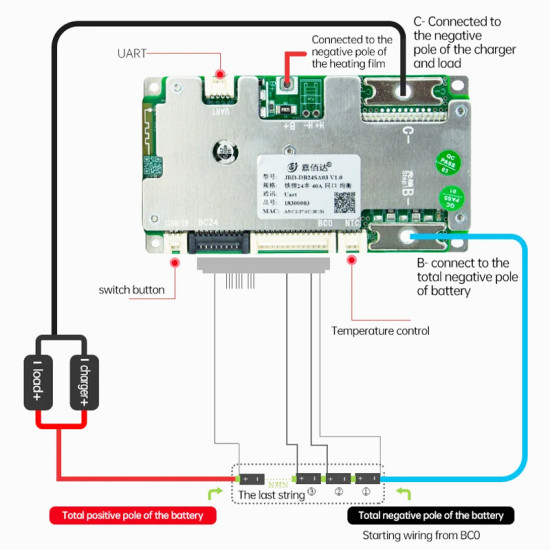
Reliable operation demands correct wiring sequencing. The high-current terminals are clearly designated on the PCB: the B- pad connects directly to the absolute negative terminal of the lowest cell in the series string (Cell 1 Negative), while the C- pad serves as the common ground connection for both the external charging source negative and the electrical load negative. The positive load and charger lines connect directly to the main positive terminal of the top cell in the pack.

Cell monitoring is established through the high-density balance wiring harness (JST multi-pin format). Pin 1 (BC0) must connect to Cell 1 Negative (shared reference with B-). Pin 2 (BC1) attaches to the junction between Cell 1 Positive and Cell 2 Negative. Subsequent pins (BC2, BC3, up through BC14) connect sequentially to the inter-cell junctions. The final balance pin (BC15 in a 15S pack) connects to the pack main positive terminal. When configuring the board for lower cell series configurations (such as 10S, 12S, or 13S), specific upper balance lines must be bridged or configured according to the JBD hardware strapping guide. The auxiliary connectivity includes a dedicated 2-pin JST connector for the external NTC thermal probe, a 4-pin UART connector (Pin 1: VCC 3.3V/5V out, Pin 2: RXD, Pin 3: TXD, Pin 4: GND), and an independent 4-pin RS485 communication terminal (Pin 1: VCC, Pin 2: RS485-A, Pin 3: RS485-B, Pin 4: GND).

Application Use-Case

1: Light Electric Vehicles (E-Bikes and E-Scooters)

In high-power 48V or 52V commuter e-bikes and performance electric scooters, the SP15S020A V1.1 acts as the central brain. Its 50A continuous delivery easily supports 1500W to 2500W motor controllers, while the 150A peak limit provides the punch required for steep hill climbs and rapid starts without nuisance tripping.

2: Off-Grid Solar Energy Storage Systems (ESS)

For residential or remote telecom solar setups running 24V or 48V LiFePO4 battery banks (typically 8S or 15S/16S configurations), the BMS interfaces with solar charge controllers and inverters. The RS485 bus facilitates long-range data logging to central automation computers, while passive balancing prevents pack degradation during chronic partial state-of-charge (PSOC) cycling.

3: Automated Guided Vehicles (AGVs) and Robotics

Warehouse logistics AGVs and autonomous mobile robots (AMRs) require deterministic reliability and accurate remaining runtime predictions. The precise coulomb counter within the JBD SP15S020A supplies serial telemetry over UART to the robotic central compute unit, alerting the operating system when the robot must return to its autonomous docking bay for opportunistic charging.

4: Marine Electric Propulsion and Trolling Motors

Trolling motors and small electric outboard boats demand steady current flow in moist, thermally demanding environments. The external NTC sensor allows operators to monitor deep-pack core temperatures during extended trolling runs, while the Bluetooth mobile interface lets boaters inspect individual cell health and remaining amp-hours directly from a smartphone.

5: Portable Emergency Power Stations

High-capacity portable battery generators use the SP15S020A to manage NMC or LiFePO4 cells arranged in compact spaces. The multi-chemistry selectability permits high-energy-density NMC integration, while short-circuit protection safeguards against user error on exposed external high-amperage output jacks.

6: Commercial Drone Ground Stations and Field Basecamps

Ground control stations (GCS) and portable high-draw battery field chargers rely on stable 36V or 48V field buffer packs. The BMS ensures that field recharge cycles from erratic inputs (such as portable gas generators or folding solar blankets) never exceed the precise over-voltage safety limits of sensitive lithium storage arrays.

7: Electric Golf Carts and Utility Task Vehicles (UTVs)

Retrofitting legacy lead-acid golf carts with 48V LiFePO4 modules requires a high surge threshold to handle high stall currents from DC series motors. The SP15S020A handles these initial inductive inrushes through its 150A 1-second pulse margin, cutting the dead weight of the vehicle by over 100 kilograms.

8: Critical Telecom and Network Backup Units

Server racks, cellular repeaters, and remote microwave links rely on 48V DC bus architectures. The board ensures the continuous availability of reserve power during main line grid drops. RS485 integration permits seamless networking of multiple battery modules into central monitoring dashboards for proactive field servicing.

Official Resources & Manuals

Ginō Ginō AI - Nerokas AI Assistant
✕
Jambo! I am Ginō, a Nerokas AI Assistant and Africa's best Open Hardware Facilitator AI agent here to help. In order to serve you better and to help me give you accurate shipping estimates as we begin, could you please tell me your name and your location/city?

You can also ask about any hardware or type I'd like to order, I am looking for..., you can also LIST all SKUs & Quantity of desired items from our website here for me to help you Checkout automatically at anytime to fast-track your requests and orders.