Menu
Your Cart
NOTICE: We have Fully discontinued physical walk-in customer service, RFQ, and LPO processing. Nerokas is now a FULLY DIGITAL ONLINE STORE, and our virtual assistant, Ginō AI, is here to help you navigate and checkout. Just ADD your Items to cart and type CHECKOUT on Ginō. Please note that corporate customers must register a corporate account to ensure proper Digital eTIMS/VAT processing.

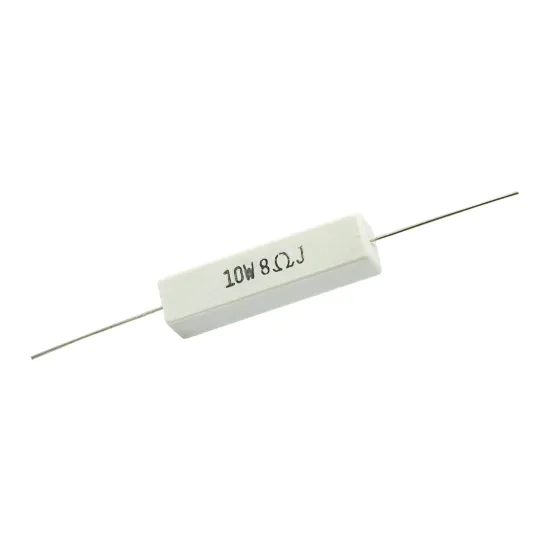
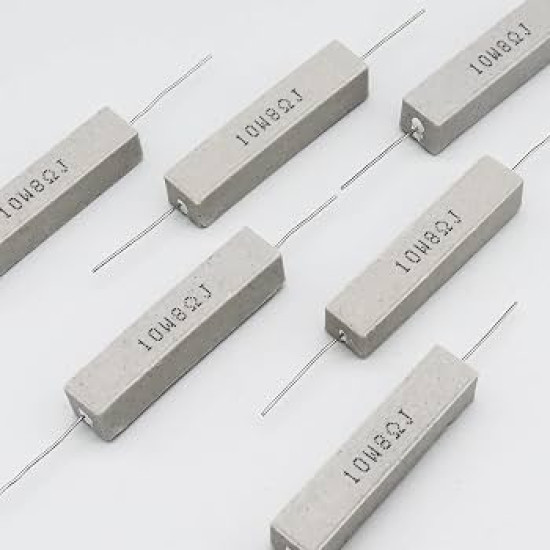
8 ohm 10 Watt Wirewound Resistor

8 ohm 10 Watt Wirewound Resistor
Out Of Stock
8 ohm 10 Watt Wirewound Resistor
KES 50.00
  • Stock: Out Of Stock
  • Model: 8 ohm 10 Watt Resistor
  • Weight: 11.20g
  • Dimensions: 48.00mm x 10.00mm x 10.00mm
  • SKU: 3896

Engineering Overview of the 8 Ohm 10 Watt Power Resistor

The 8 Ohm 10 Watt ceramic cement power resistor is a ruggedized passive component engineered for demanding electronic circuits requiring high thermal dissipation, high pulse endurance, and steadfast electrical stability. Designed around an advanced wirewound resistive element sealed inside an inorganic steatite ceramic casing, this power component stands up to extreme operating conditions where standard thick-film or metal-film resistors would rapidly degrade or fail. Operating with a nominal resistance value of 8 ohms and an continuous power dissipation capability of 10 watts in free air, this device maintains a tight plus or minus 5 percent manufacturing tolerance, guaranteeing reliable performance across commercial, automotive, audio, and industrial applications.

Wirewound power resistors remain the definitive industry standard for applications that experience high surge currents, repetitive voltage transients, and substantial thermal cycling. The fundamental structure utilizes a high-grade resistive alloy winding that evenly distributes electrical energy along its core, completely avoiding the microscopic localized hot spots common to thin-film alternatives. Housed in a non-flammable, rectangular ceramic body and potted with a specialized silica-based cement, the resistor ensures maximum thermal conduction from the internal core to the ambient environment while providing electrical isolation, flame retardance, and total protection against ambient humidity and chemical contaminants.

Physical Architecture and Material Composition

At the center of this 10W resistor lies a high-purity, non-alkaline ceramic core possessing superior mechanical strength and thermal conductivity. Around this core, a high-precision resistance wire manufactured from premium nickel-chromium or copper-nickel alloy is wound with uniform pitch to maintain balanced resistance and uniform thermal distribution. The winding terminations are joined to robust end caps using metallurgical welding techniques, creating a solid bond that eliminates contact resistance variations and mechanical failures caused by cyclical expansion and contraction.

The assembly is sealed inside a high-density steatite ceramic block utilizing an inorganic, non-conductive potting cement. This cement compound acts as an efficient thermal conduit, swiftly moving thermal energy generated along the wirewound element outward to the ceramic enclosure. Steatite provides exceptional mechanical rigidity and dielectric breakdown resistance, effectively isolating high internal voltages from adjacent circuit components. The exterior leads are composed of high-purity tinned copper, delivering superior solderability, low lead resistance, and long-term resistance to oxidation.

Thermal Dynamics, Derating, and Environmental Resilience

Thermal management is a critical parameter in the application of high-power passive components. This 8 Ohm resistor is engineered to sustain its full rated power of 10 watts at ambient temperatures up to 70 degrees Celsius in free-convective air. Beyond this threshold, thermal derating must be applied linearly down to zero power dissipation at maximum operating temperatures, which typically reach 275 degrees Celsius. The robust ceramic cement construction offers an intrinsically flameproof envelope; even under severe fault conditions or excessive overload, the component will not ignite or emit conductive carbonaceous residue.

Humidity and moisture ingress can cause catastrophic electrolytic corrosion and dielectric tracking in lesser components. This resistor solves these environmental vulnerabilities through its hermetically bonded cement filling and inert steatite casing. The component passes rigorous environmental stress screenings, maintaining exceptional insulation resistance exceeding 1000 megaohms and showing zero degradation in structural or electrical characteristics across high-humidity test environments. Its low temperature coefficient of resistance guarantees that shifts in ambient temperature or internal operational heating cause minimal drift in nominal impedance.

Pinout and Terminal Configuration

This high-power resistor utilizes a non-polarized, bi-directional 2-pin axial lead configuration. Because it is a purely passive resistive element, either terminal can be designated as the input or output.

Lead 1 (Axial Terminal A): High-conductivity, tinned copper wire lead providing mechanical support and low-resistance electrical connection to the internal resistive winding. Can be soldered directly to plated through-holes on a printed circuit board, secured into terminal blocks, or wired using point-to-point soldering.

Lead 2 (Axial Terminal B): Opposing axial lead structurally and electrically identical to Lead 1, completing the resistive circuit. Possesses equal thermal dissipation capability, carrying heat from the core directly into the PCB trace or connection lug.

Mounting Note: Because high thermal energy is generated when dissipating the full 10-watt rating, it is recommended to elevate the resistor body at least 5 mm to 10 mm above the printed circuit board surface to prevent board discoloration and allow unimpeded natural convective airflow around all four sides of the ceramic block.

Application Use-Case

1: Audio Amplifier Dummy Load and Bench Testing

An 8-ohm resistance is the international baseline impedance standard for high-fidelity audio equipment, loudspeaker drivers, and commercial power amplifiers. During laboratory development, audio servicing, and production line calibration, technicians cannot use acoustic speakers without generating dangerous noise levels. This 8 Ohm 10W resistor acts as an ideal non-acoustic dummy load, absorbing the audio output power while allowing precise measurement of harmonic distortion, clipping headroom, signal-to-noise ratio, and frequency response without disturbing the working environment.

2: Loudspeaker Passive Crossover Networks

In multi-driver speaker systems, passive crossover networks separate audio frequencies into discrete bands for subwoofers, mid-range cones, and tweeters. High-efficiency drivers often display sensitivity mismatches compared to lower-efficiency companions, requiring attenuation networks known as L-pads. This 10-watt resistor serves as an attenuation element within L-pad circuits, maintaining a constant 8-ohm load profile seen by the amplifier while safely dissipating excess high-frequency audio power as heat without adding harmonic distortion.

3: Switch-Mode Power Supply (SMPS) Snubber Circuits

High-frequency power switching transistors, such as MOSFETs and IGBTs in buck, boost, and flyback topologies, generate intense inductive voltage spikes during turn-off cycles due to transformer leakage inductance. Placed in series with a high-voltage ceramic capacitor to form an RC snubber network, this 8-ohm resistor dampens high-frequency ringing, suppresses electromagnetic interference (EMI), and absorbs energy spikes, preventing destructive drain-to-source overvoltage conditions.

4: Inrush Current Limiting in Capacitive Filter Banks

Large DC bus smoothing capacitors in linear power supplies, un-interruptible power supplies (UPS), and motor controllers represent a virtual short circuit upon initial power application. Inserting this 8-ohm power resistor in series with the rectifier output restricts instantaneous inrush current to safe, manageable thresholds. Once the capacitors charge to operational levels, an electromechanical relay or bypass triac can short out the resistor, removing it from the running circuit after it has successfully protected the upstream fuses and bridge rectifiers.

5: DC Motor Dynamic Braking and Soft Starting

When current to a rotating permanent-magnet DC motor is suddenly severed, the motor acts as an electrical generator due to counter-electromotive force (back-EMF). By switching this 8-ohm, 10-watt resistor across the disconnected motor terminals, the mechanical kinetic energy of the rotating armature is converted into electrical energy and dissipated as thermal energy within the resistor. This action decelerates the motor rapidly and smoothly without mechanical wear, creating an effective, low-cost dynamic braking system.

6: Battery Discharge Testing and Profiling

Accurate profiling of secondary battery chemistries, including Lithium-Iron-Phosphate (LiFePO4), Lithium-Ion, and sealed lead-acid (SLA) cells, requires controlled discharge cycles at predictable current drains. Connected across a 3.7V nominal cell, an 8-ohm resistor draws approximately 460 mA of constant resistive current, generating roughly 1.7 watts of continuous power well within the 10W envelope. This enables consistent multi-hour capacity measurements, internal resistance calculations, and degradation monitoring across thermal test chambers.

7: LED Array Ballast and Fault Emulation

Automotive control modules and industrial lighting controllers frequently monitor load resistance to detect burnt-out lamps. When retrofitting energy-efficient LED modules into systems originally engineered for incandescent or halogen lamps, hyper-flashing or false warning lights appear due to low LED current draw. Connecting this 8-ohm power resistor in parallel with the lighting circuit simulates the anticipated electrical burden of a filament bulb, stabilizing the vehicle flasher relay and satisfying the internal diagnostic polling routines of the body control unit.

8: Solenoid and Inductive Actuator Spark Quenching

Industrial automation relies heavily on electromechanical solenoids, magnetic valves, and heavy-duty contactors. Rapid de-energization of these high-inductance coils results in massive inductive kickback voltages that arc across relay contacts and destroy controlling transistors. Placed across the inductive load in combination with a flywheel diode or bipolar transient suppressor, the 8-ohm 10W resistor provides rapid, controlled magnetic flux collapse, absorbing high transient energy pulses repeatedly over millions of industrial machine cycles.

Quality Assurance and Compliance

Every unit undergoes strict quality control protocols, confirming dimensional accuracy, lead integrity, and precise terminal resistance within the stated 5% tolerance window. Manufactured in strict conformity with European Union RoHS and REACH environmental directives, the component is completely free of hazardous substances, including lead, mercury, hexavalent chromium, and polybrominated biphenyls. Its rugged mechanical design makes it suitable for wave soldering and high-reliability industrial assembly lines.

Ginō Ginō AI - Nerokas AI Assistant
✕
Jambo! I am Ginō, a Nerokas AI Assistant and Africa's best Open Hardware Facilitator AI agent here to help. In order to serve you better and to help me give you accurate shipping estimates as we begin, could you please tell me your name and your location/city?

You can also ask about any hardware or type I'd like to order, I am looking for..., you can also LIST all SKUs & Quantity of desired items from our website here for me to help you Checkout automatically at anytime to fast-track your requests and orders.