

















New
Out Of Stock


SKYRC B6Neo: Balance Lipo Battery Charger for 1S-6S Lipo/Li-Ion/LiHV, 1-15S NiMH/NiCd - DC 200W, PD 80W, Smart Battery Charger, Discharger and Storage (Blue-Red) TYPE C
KES 7,500.00
- Stock: Out Of Stock
- Model: SkyRC-B6Neo
- SKU: 4015

Your shopping cart is empty!


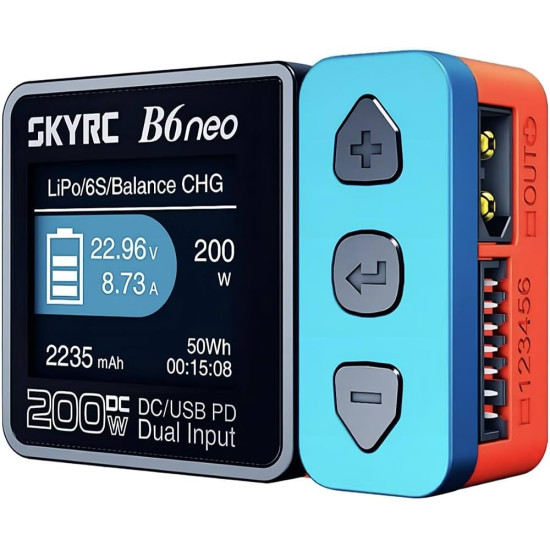
The SkyRC B6neo represents a technological leap forward in high-density DC power electronics and battery management. Measuring a mere 70 by 50 by 32 millimeters and tipping the scales at just 82 grams, the B6neo condenses benchtop-grade multi-chemistry battery charging into an ultra-compact form factor smaller than a standard credit card footprint. Engineered specifically for RC hobbyists, field robotics engineers, and drone pilots who demand extreme portability without compromising on throughput, the B6neo integrates a sophisticated synchronous buck-boost converter topology capable of delivering up to 200W under direct DC input and up to 80W when powered via modern USB Power Delivery (USB-PD 3.0) and Quick Charge protocols.
Constructed within an impact-resistant, flame-retardant PC-ABS V0 polymer enclosure, the B6neo is purpose-built to withstand the rigors of field operations while isolating internal electronics from external mechanical shock and environmental stress. The charging system is controlled by an advanced high-speed micro-controller unit (MCU) executing custom state-machine firmware. This embedded controller continuously monitors input bus stability, duty-cycle thermal shifts, internal shunt temperatures, and per-cell delta-peak or voltage-cutoff thresholds at millivolt accuracy, ensuring both optimal energy transfer efficiency and total operational safety.
Human-machine interaction is mediated via SkyRC's proprietary ColorX user interface displayed on a vibrant 1.77-inch TN color screen. Operating at a resolution of 128 by 160 pixels with 262,000 selectable colors, the screen provides high-contrast, sunlight-readable real-time telemetry. Key charging parameters—such as overall pack voltage, per-cell individual voltages, charged capacity (in milliamp-hours), instantaneous charging amperage, internal pack resistance, and elapsed cycle time—are rendered via clean, distinct color-coded graphical blocks. Navigation is handled through a three-button tactile membrane switch system located beneath the display, allowing intuitive cycling between configuration menus, chemical profiles, cut-off thresholds, and operating modes without the convoluted multi-tier navigation trees characteristic of older legacy chargers.
To deliver maximum operational flexibility across laboratory, field, and emergency charging scenarios, the SkyRC B6neo incorporates a dual-source power input architecture. The primary power bus uses an industry-standard XT60 male interface configured to accept an unregulated DC input spectrum ranging from 10.0V to 28.0V. When connected to high-capacity DC power supplies, deep-cycle lead-acid field batteries, or high-capacity 4S-6S LiPo packs, the B6neo achieves its maximum power output of 200W, driving charge currents up to an impressive 10.0A.
For ultra-light travel and field scenarios where carrying a bulky dedicated DC power supply is impractical, the B6neo features an auxiliary USB Type-C input utilizing advanced hardware PD/QC negotiation chips. Supporting both USB Power Delivery 3.0 and Quick Charge 3.0 standards, the charger can negotiate input rails from 12.0V up to 20.0V at current limits specified by the host supply, outputting a maximum of 80W charge power. This allows users to power the B6neo directly from modern GaN wall adapters, high-output USB-C power banks, or automotive USB-C accessory jacks.
The SkyRC B6neo supports virtually every primary rechargeable electrochemical composition utilized in modern electronics and RC platforms. Supported chemistries include Lithium Polymer (LiPo), High-Voltage Lithium Polymer (LiHV), Lithium Iron Phosphate (LiFe), Lithium-Ion (Li-Ion), Nickel-Metal Hydride (NiMH), Nickel-Cadmium (NiCd), and Lead-Acid (Pb). Cell count capability spans from 1S to 6S for all lithium-based chemistries, 1 to 15 cells for nickel-based chemistries, and 3S to 6S (6V to 12V nominal) for lead-acid formulations.
Balancing precision is maintained through an integrated, board-level active balancing subsystem capable of sinking up to 500mA per cell. By shunting excess charge current around fully balanced cells during the constant-voltage (CV) charging phase, the B6neo eliminates inter-cell voltage discrepancies with exceptional speed, extending battery longevity and maximizing flight or run times. In addition, the balance port serves an active diagnostic role: with the balance lead connected, the unit functions as an internal resistance (IR) meter and battery state-of-charge checker, revealing individual cell degradation before a weak cell fails under load.
Battery maintenance is critical for extending cell health, particularly for lithium formulations that suffer accelerated degradation when stored at full charge. The B6neo features a comprehensive set of auxiliary operational modes, including Discharge, Storage, and automated Cycling. In standard discharge mode, the unit utilizes internal passive dissipation to discharge packs at currents from 0.1A to 2.0A up to a thermal limit of 10W. However, when an external balance lead is connected, the intelligent power-sharing circuit raises the allowable discharge power limit up to 24W, significantly accelerating the process of bringing flight packs down to a stable 3.80V-3.85V per cell storage state after an aborted mission.
Transcending the functionality of a standalone battery charger, the B6neo includes a programmable DC Power Supply mode. Through this software-driven mode, the user can configure the XT60 output port to act as an adjustable, current-limited bench power supply. The voltage can be set with 0.1V precision across a wide range, while current limits can be dialed from 0.1A to 10.0A. This allows hardware engineers and service technicians to power prototypes, drive DC soldering irons, test brushed motors, and verify low-voltage circuit functionality without requiring a dedicated benchtop supply unit.
High power density naturally generates localized thermal buildup. To counteract this, the B6neo features an internal aluminum finned heat sink paired with a high-RPM miniature hydraulic-bearing cooling fan. Smart thermal throttling firmware regulates fan speed dynamically based on internal NTC thermistor feedback. Operating at full thermal load, noise emissions remain strictly capped around 48 decibels, ensuring a quiet bench environment during sustained charging operations. If internal temperatures exceed safe operating limits due to restricted airflow, the charger automatically derates output current before triggering safety shutdown protocols.
The SkyRC B6neo features five primary physical interfaces designed for high reliability and zero-insertion-error connectivity:
1. DC Input Port (XT60 Male): Located on the input side panel, this polarized high-current connector accepts direct DC supplies between 10.0V and 28.0V. The flat side corresponds to positive voltage (+), while the chamfered/angled side corresponds to negative ground (-). Capable of sustaining input currents up to 15A continuous.
2. USB Type-C Input and Data Port: Located alongside the DC input, this 24-pin reversible Type-C female receptacle supports PD3.0 and QC inputs from 12V to 20V. In addition to power input, this port interfaces with a host PC running the SkyRC Charger Master application, allowing bi-directional telemetry logging and MCU firmware updates.
3. Main Output Port (XT60 Female): Positioned on the output panel, this port connects to the primary battery leads. It delivers regulated charge currents from 0.1A to 10.0A and supports programmable DC power output. Like the input port, the flat housing edge designates the positive terminal (+), and the chamfered edge designates the ground terminal (-).
4. 6S JST-XH Balance Port: An integrated 7-pin keyed JST-XH socket configured for direct connection of 2S through 6S balance plugs without requiring an external balance board. Pinout architecture follows standard industry convention from ground upward: Pin 1 (far right, marked negative) connects to Battery Ground / Pack Negative; Pin 2 connects to Cell 1 Positive; Pin 3 connects to Cell 2 Positive; Pin 4 connects to Cell 3 Positive; Pin 5 connects to Cell 4 Positive; Pin 6 connects to Cell 5 Positive; and Pin 7 connects to Cell 6 Positive / Pack Positive. When connecting 2S to 5S packs, the connector must be aligned flush to the negative (Pin 1) reference.
5. Micro Fan Exhaust Port: Precision-milled directional ventilation slots located on the rear and underside of the housing to facilitate laminar exhaust airflow through the heatsink array.
1. Professional FPV Drone Racing and Freestyle Operations: High-performance quadcopters utilize 4S and 6S LiPo/LiHV packs ranging from 1000mAh to 1500mAh with continuous discharge requirements exceeding 100C. The B6neo enables pilots to achieve 2C to 5C rapid field recharges via a portable 24V field battery or a high-wattage GaN USB-PD power bank, reducing turnaround time between race heats to under fifteen minutes.
2. Commercial Autonomous Fixed-Wing UAV Mapping: Aerial surveying platforms rely on large 4S to 6S Li-Ion (18650/21700) endurance packs. The B6neo delivers tailored constant-current/constant-voltage (CC/CV) profiles with fine-tuned termination voltages, allowing survey crews to condition long-range endurance packs directly from a vehicle auxiliary port or field generator without transporting bulky bench chargers.
3. Competitive RC Surface Model Pit Lane Management: RC drift, buggy, and touring car platforms run 2S shorty LiPo and LiHV packs. The internal resistance meter on the B6neo allows pit mechanics to verify pack integrity and matched cell degradation instantly before competitive mains, while the 200W DC charge capability brings packs to the legal maximum 8.40V or 8.70V limit swiftly.
4. Remote Hardware Engineering and Field Servicing: Hardware developers working on embedded microcontrollers, IoT sensor nodes, and field telemetry gateways can configure the B6neo into Digital DC Power Supply mode. This replaces a dedicated lab power supply, enabling technicians to deliver regulated voltage from 5V to 27V directly to prototypes in harsh remote field conditions.
5. Tactical Airsoft Fleet Maintenance: Airsoft electric guns (AEGs) utilize 2S and 3S stick or nunchuck LiPo and LiFe packs fitted inside tight stock compartments. The B6neo ensures balanced charging, prevents dangerous cell over-discharge via automatic cutoff thresholds, and offers a dedicated storage charge cycle to maintain pack health between tactical events.
6. Marine Remote Control Racing and High-Power Watercraft: RC speedboats require high-capacity, multi-cell lithium batteries that generate significant heat during runs. The B6neo's advanced diagnostic suite measures post-run internal resistance and balanced thermal recovery, ensuring batteries are properly checked and cycled before high-amperage redeployment.
7. Robotics Development Lab Prototyping: University robotics labs and commercial automated guided vehicle (AGV) teams frequently experiment with varied battery chemistries, from safe LiFePO4 cells to high-current NiMH arrays. The versatile multi-chemistry firmware within the B6neo allows researchers to test and recharge custom pack configurations using a single unified charging platform.
8. Lead-Acid Auxiliary and Backup Battery Float Conditioning: Beyond lithium and nickel cells, the B6neo supports 3S and 6S Pb (lead-acid) chemistries. Field engineers can maintain and float-charge sealed lead-acid (SLA) or gel-cell batteries used in portable repeater towers, uninterruptible power supply (UPS) enclosures, and emergency backup lighting systems.
Ginō AI - Nerokas AI Assistant