Menu
Your Cart
NOTICE: We have Fully discontinued physical walk-in customer service, RFQ, and LPO processing. Nerokas is now a FULLY DIGITAL ONLINE STORE, and our virtual assistant, Ginō AI, is here to help you navigate and checkout. Just ADD your Items to cart and type CHECKOUT on Ginō. Please note that corporate customers must register a corporate account to ensure proper Digital eTIMS/VAT processing.

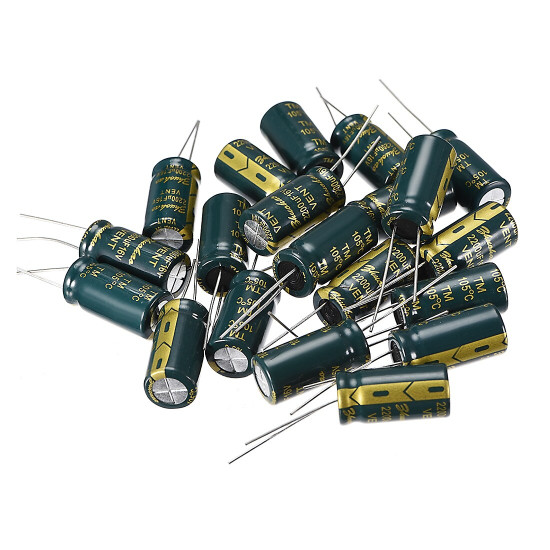
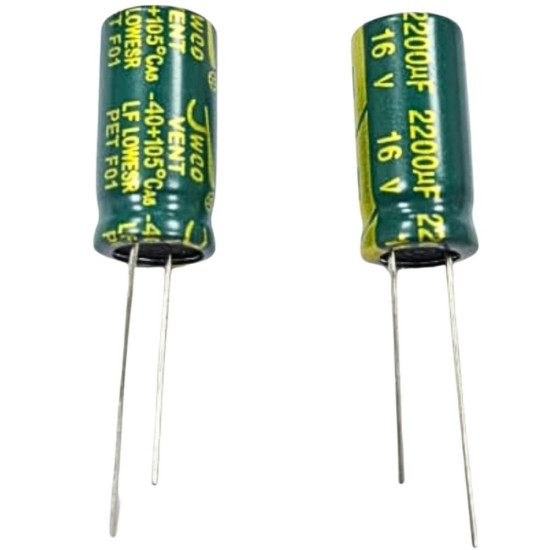
2200uF 16V Radial Aluminum Electrolytic Capacitor

2200uF 16V Radial Aluminum Electrolytic Capacitor
New
2200uF 16V Radial Aluminum Electrolytic Capacitor
KES 40.00
  • Stock: In Stock
  • Model: 2200uF 16V Radial Aluminum Ele
  • Weight: 3.20
  • Dimensions: 10.00 x 10.00 x 20.00
  • SKU: 546

Product Overview

The 2200uF 16V radial aluminum electrolytic capacitor is an indispensable passive energy storage component engineered to address demanding filtering, reservoir, and decoupling requirements in modern electronics. Housing a massive electrostatic capacity of 2200 microfarads within a compact cylindrical footprint, this component stabilizes varying direct-current voltages, suppresses low-to-mid frequency switching harmonics, and maintains uninterrupted operational stability across industrial, automotive, audio, and consumer power distribution networks. By leveraging high-purity aluminum foil and an advanced liquid electrolyte formulation, this capacitor delivers a balanced combination of high volumetric efficiency, low Equivalent Series Resistance (ESR), and exceptional ripple current tolerance.

Electrochemical Architecture and Physical Construction

Internally, this aluminum electrolytic capacitor consists of high-purity etched aluminum anode and cathode foils wound into a cylindrical roll, commonly referred to as the element or jelly roll. The anode foil undergoes an electrochemical forming process that grows a molecularly thin barrier layer of aluminum oxide (Al2O3), which functions as the dielectric medium. Because the thickness of this dielectric layer is directly proportional to the rated breakdown voltage, the 16V working voltage rating allows for an ultra-thin oxide barrier, maximizing capacitance density per unit volume. The cathode foil functions primarily as an electrical contact to the liquid working electrolyte, which permeates the porous structure of the specialized separator paper. The liquid electrolyte serves as the true functional cathode, conforming intimately to every etched microscopic crevice of the anode oxide film. The entire structure is sealed within a corrosion-resistant aluminum can backed by an elastomer rubber end seal that prevents dry-out and ensures long-term retention of volatile solvent compounds under fluctuating operating conditions.

Comprehensive Technical Specifications

Nominal Capacitance: 2200 microfarads (uF)
Rated Working Voltage (WVDC): 16 Volts DC
Surge Voltage Capability: 20 Volts DC maximum transient threshold
Capacitance Tolerance: plus or minus 20 percent measured at 120Hz and 20 degrees Celsius
Operating Temperature Range: -40 degrees Celsius to +105 degrees Celsius
Rated Load Life: 2000 to 5000 hours at 105 degrees Celsius (extrapolating to over 50000 hours at typical 45 degrees Celsius ambient levels)
Dissipation Factor (tan delta): less than or equal to 0.16 at 120Hz and 20 degrees Celsius
Leakage Current: I is less than or equal to 0.01CV or 3 microamps (whichever is greater) after a two-minute stabilization window
Can Dimensions: 10mm outer diameter by 20mm body height
Lead Spacing (Pitch): 5.0mm plus or minus 0.5mm center-to-center
Lead Material: Tinned copper-clad steel wire facilitating superior solderability and mechanical shear strength

Polarity, Pinout, and Mechanical Interfacing

Aluminum electrolytic capacitors are polarized devices requiring strict adherence to voltage orientation during installation. The pinout configuration is straightforward yet critical to circuit reliability:
Pin 1 (Anode / Positive Lead): Longer terminal lead intended for connection to the positive potential rail. This lead interfaces directly with the formed dielectric oxide plate inside the housing.
Pin 2 (Cathode / Negative Lead): Shorter terminal lead intended for connection to ground or the lowest relative potential node. Externally, the negative polarity is marked on the outer PVC or PET insulation sleeve by a thick longitudinal stripe displaying negative minus signs and downward-pointing chevrons.
Reversing polarity induces rapid electrochemical breakdown of the aluminum oxide dielectric layer, causing excessive forward leakage current, ohmic heating, gas evolution, internal overpressurization, and structural activation of the safety pressure vent stamped into the top of the aluminum can.

Thermal Dynamics and Extended Operational Life

The operational endurance of this 105 degrees Celsius rated capacitor follows the Arrhenius chemical reaction rate rule, which indicates that for every 10 degrees Celsius reduction in core operating temperature below the rated ceiling, expected operating lifespan doubles. While operating continuously at 105 degrees Celsius yields approximately 2000 to 5000 hours depending on applied ripple current, running the component at an ambient operating environment of 55 degrees Celsius scales operational longevity up to 64000 hours. The robust elastomer bung formulation actively impedes liquid electrolyte evaporation, mitigating premature failure modes characterized by gradual capacitance loss and ESR escalation over prolonged duty cycles.

Equivalent Series Resistance and Ripple Current Handling

Every non-ideal capacitor exhibits Equivalent Series Resistance (ESR), resulting from the collective resistivities of the electrolyte solution, internal tabs, terminal foils, and external leads. In high-frequency switching environments, ripple currents flowing through the ESR create internal I-squared-R resistive power dissipation that raises the core temperature of the capacitor. This 2200uF 16V capacitor features optimized electrolyte conductive pathways and heavy multi-tab winding internal junctions to lower the ESR profile. Consequently, the component reliably sustains elevated RMS ripple current loads, suppressing voltage ripple under transient loading conditions without experiencing debilitating localized thermal runaway.

Application Use-Case

1: Switch-Mode Power Supply Output Filtering

In offline flyback, forward, and push-pull switch-mode power supplies (SMPS) converting AC mains to a regulated 5V, 9V, or 12V DC bus, this 2200uF 16V capacitor functions as a primary secondary-stage output filter. Positioned directly after the secondary rectifier diode, it integrates pulses of high-frequency energy, absorbs peak current swings, and smooths residual switching noise down to millivolt thresholds, delivering clean, stable direct current to downstream processing circuitry.

2: Audio Power Amplifier Rail Decoupling

High-fidelity Class-AB and Class-D audio amplifiers demand rapid, unconstrained current reserves during dynamic acoustic transients, such as deep bass notes and high-amplitude drum transients. When placed across the single-supply or split-rail power buses feeding the final audio power stages, this 2200uF reservoir capacitor stores charge locally. By minimizing rail sag under heavy transient draws, it prevents clipping distortion, suppresses intermodulation artifacts, and maintains pristine dynamic headroom across the audible spectrum.

3: Automotive 12V Electrical Bus Conditioning

The automotive 12V battery network is notoriously hostile, subject to severe load dump events, inductive spikes from alternator fields, and voltage dips during engine ignition crank cycles. Installed on auxiliary accessory boards, infotainment controllers, and automotive sensor modules, this capacitor acts as an energy buffer and ripple attenuator, absorbing high-energy transients and bridging microsecond dropout windows to protect sensitive microcontrollers from unwanted brownout resets.

4: DC-DC Step-Down Buck Converter Output Smoothing

Step-down switching regulators operating from 12V or 15V inputs down to low-voltage logic domains benefit substantially from this capacitor positioned at the buck converter output. Paired with a power inductor, it establishes a classic second-order low-pass LC filter network that strips away high-frequency square wave harmonics, maintaining output ripple within tight percentage bounds under dynamic step-load conditions encountered when digital microprocessors rapidly transition between idle and active processing states.

5: Full-Wave Linear Power Supply Smoothing

In classical linear power supplies utilizing a step-down iron-core mains transformer and a full-wave diode bridge, the rectified output consists of pulsing 100Hz or 120Hz half-sine waves. Installing this 2200uF bulk capacitor directly across the bridge rectifier output bridges the valleys between voltage peaks. With a standard 1A load, 2200uF limits peak-to-peak ripple voltage to approximately 3.8 volts, ensuring that linear voltage regulators like the LM7805 or LM7812 maintain sufficient drop-out headroom continuously.

6: DC Motor and Stepper Driver Inductive Snubbing

H-bridge motor drivers controlling DC brush motors, stepper actuators, and multi-rotor brushless motors generate massive inductive back-EMF spikes during PWM switching cycles and hard braking sequences. Connected directly across the high-voltage supply pins of the driver IC, this capacitor absorbs the reverse regenerative energy surges, clamping destructive voltage peaks and preserving the silicon junctions of power MOSFET switching arrays.

7: Solar Micro-Inverter and Harvester Buffer

Small-scale photovoltaic panels and micro-harvesting systems experience fluctuating illumination that induces unpredictable fluctuations in output current. Placed along the maximum power point tracking (MPPT) DC input bus, this capacitor serves as an intermediate energy reservoir. It stabilizes source impedance, prevents voltage collapse during irradiance transitions, and allows the digital tracking algorithm to compute stable energy harvesting points.

8: Embedded System Brownout Protection

Critical computing devices, such as industrial IoT gateways, edge telemetry systems, and network communication modules, risk storage corruption if power fails abruptly during an active flash-memory write cycle. This 2200uF 16V capacitor provides critical hold-up time on a regulated 12V rail. Upon input power termination, the stored energy discharges through a low-dropout regulator, granting the microcontroller several milliseconds of additional operating time to conclude open transactions, save diagnostic flags, and execute an orderly shutdown.

Design Best Practices and Layout Guidelines

To maximize performance and operating life, designers should de-rate operating voltage by at least 20 percent, running this 16V capacitor at nominal supply levels of 12.8V or below. On printed circuit boards, place the capacitor terminals in close physical proximity to the primary switching elements to minimize parasitic loop inductance. Avoid routing high-temperature traces or locating heat-generating elements, such as power resistors, heatsinks, and power transistors, directly beneath or adjacent to the capacitor body to prevent premature electrolyte dry-out and maximize overall system reliability.

Ginō Ginō AI - Nerokas AI Assistant
✕
Jambo! I am Ginō, a Nerokas AI Assistant and Africa's best Open Hardware Facilitator AI agent here to help. In order to serve you better and to help me give you accurate shipping estimates as we begin, could you please tell me your name and your location/city?

You can also ask about any hardware or type I'd like to order, I am looking for..., you can also LIST all SKUs & Quantity of desired items from our website here for me to help you Checkout automatically at anytime to fast-track your requests and orders.