- Stock: In Stock
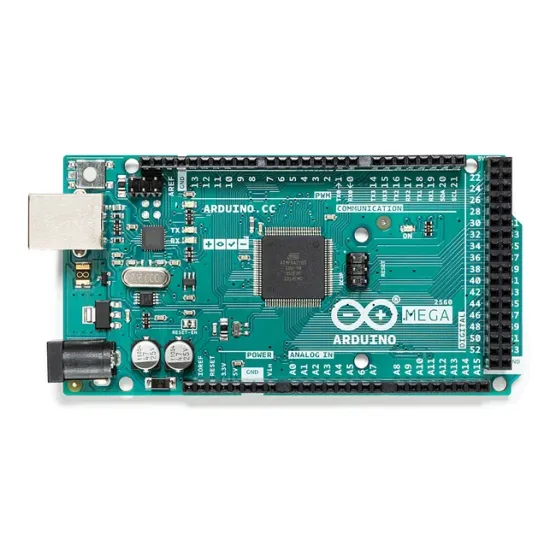
- Model: Arduino Mega 2560 R3
- Weight: 37.00g
- Dimensions: 101.52mm x 53.30mm x 12.00mm
- SKU: 5
Product Overview
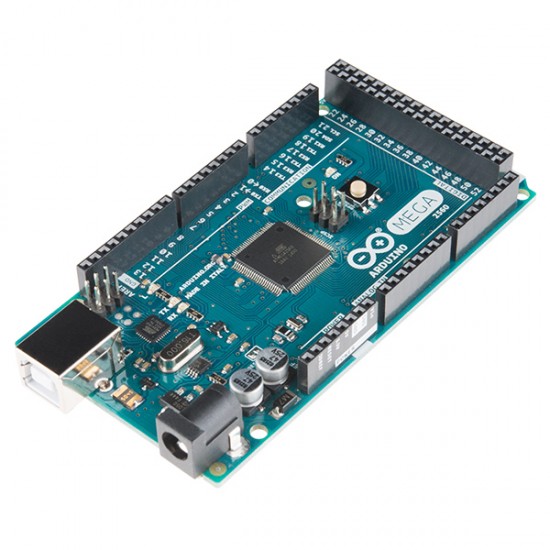
The Arduino Mega 2560 R3 is an enterprise-grade microcontroller development board powered by the high-density Microchip ATmega2560 8-bit AVR RISC microcontroller. Specifically engineered for sophisticated projects that exceed the memory and pin-count capacity of standard platforms like the Arduino Uno, the Mega 2560 R3 delivers an expansive array of digital, analog, and hardware serial interfaces. It serves as the primary processing node in multi-axis motion control systems, complex robotics platforms, 3D printers, automated environmental telemetry stations, and large-scale industrial sensor matrices while maintaining physical footprint and layout compatibility with most R3-compatible expansion shields.
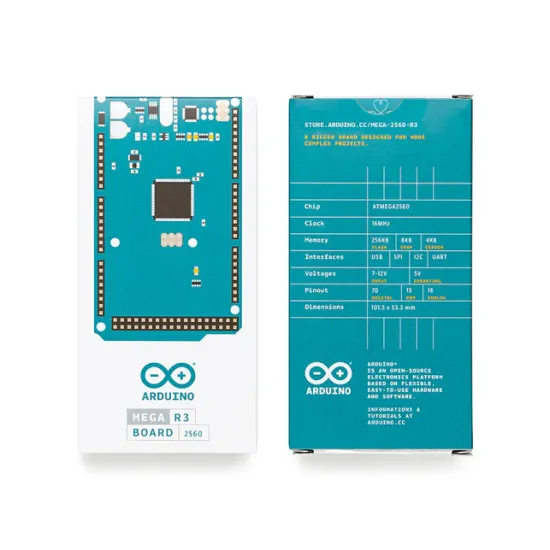
| Microcontroller | ATmega2560 |
| Operating Voltage | 5V |
| Input Voltage (recommended) | 7-12V |
| Input Voltage (limit) | 6-20V |
| Digital I/O Pins | 54 (of which 15 provide PWM output) |
| Analog Input Pins | 16 |
| DC Current per I/O Pin | 20 mA |
| DC Current for 3.3V Pin | 50 mA |
| Flash Memory | 256 KB of which 8 KB used by bootloader |
| SRAM | 8 KB |
| EEPROM | 4 KB |
| Clock Speed | 16 MHz |
| LED_BUILTIN | 13 |
| Length | 101.52 mm |
| Width | 53.3 mm |
| Weight | 37 g |
Microprocessor Architecture and Memory Hierarchy
At the core of the Arduino Mega 2560 R3 is the 8-bit ATmega2560 executing instructions at a clock frequency of 16 MHz via an onboard crystal oscillator. The AVR architecture employs a Harvard execution pipeline that achieves throughputs approaching 1 MIPS per MHz, optimizing instruction processing for real-time control loops. The memory subsystem integrates 256 KB of system Flash memory (with 8 KB dedicated to the STK500v2 bootloader), allowing developers to deploy extensive codebases, complex math libraries, and embedded graphical interface frameworks. In addition, the board provides 8 KB of static RAM (SRAM) for volatile variable storage and 4 KB of non-volatile Electrically Erasable Programmable Read-Only Memory (EEPROM) for persistent parameters such as calibration data, network IDs, and runtime state variables.
Input Output Capabilities and Peripheral Integration
The pin breakout of the Mega 2560 R3 offers unprecedented peripheral connectivity, featuring 54 digital input/output pins, each capable of sourcing or sinking up to 40 mA of DC current (20 mA recommended continuous operation). Out of these, 15 pins provide hardware-based 8-bit Pulse Width Modulation (PWM) signals for precise control over servo actuators, DC motor drivers, and LED dimming arrays. Analog signal acquisition is handled by 16 high-precision analog input channels routed to an internal 10-bit Successive Approximation Register (SAR) Analog-to-Digital Converter (ADC), yielding a standard resolution of 1024 discrete steps across a 0 to 5V input range. For external communication, the board features 4 independent hardware UART ports (Serial0 through Serial3), enabling concurrent, un-buffered serial communication with host systems, GPS receivers, cellular modems, motor controllers, and wireless transceivers without incurring software bit-banging overhead.
Power Management and Revision 3 Hardware Upgrades
Operating natively at a 5V DC logic level, the board includes a dual-power architecture with automatic source selection between USB power and an external DC supply. External power can be delivered via the 2.1mm center-positive barrel jack or the Vin power pin, accepting an input range of 7V to 12V DC (with absolute operating limits between 6V and 20V DC) regulated down to 5V and 3.3V by onboard low-dropout (LDO) voltage regulators. The Revision 3 (R3) iteration incorporates an ATmega16U2 microcontroller programmed as a high-speed USB-to-serial converter, replacing legacy FTDI chips and enabling custom USB HID profiles such as keyboards or MIDI devices. The R3 pinout additions include dedicated SDA and SCL I2C bus pins situated near the AREF header, an IOREF pin allowing attached shields to automatically adjust their logic voltage level to match the main board, and an un-connected NC pin reserved for future system signals.



Application Use-Cases and Industrial Implementations
Due to its vast IO footprint and memory headroom, the Arduino Mega 2560 R3 is the industry standard for fused filament fabrication (FFF) 3D printer firmware deployments, notably when paired with RAMPS (RepRap Arduino Mega Pololu Shield) interface boards to drive multiple stepper motor axes, heated beds, and temperature sensors simultaneously. It is equally suited for inverse kinematics robotics, automated warehouse AGVs (Automated Guided Vehicles), complex MIDI control surfaces, multi-zone HVAC and building automation systems, and high-density data logging setups requiring continuous sampling across dozens of environmental and mechanical sensors.