Menu
Your Cart
NOTICE: We have Fully discontinued physical walk-in customer service, RFQ, and LPO processing. Nerokas is now a FULLY DIGITAL ONLINE STORE, and our virtual assistant, Ginō AI, is here to help you navigate and checkout. Just ADD your Items to cart and type CHECKOUT on Ginō. Please note that corporate customers must register a corporate account to ensure proper Digital eTIMS/VAT processing.

10K Precision Metal Head Thermistor - 3950 NTC

10K Precision Metal Head Thermistor - 3950 NTC
Out Of Stock
10K Precision Metal Head Thermistor - 3950 NTC
KES 400.00
  • Stock: Out Of Stock
  • Model: 10K NTC thermistor
  • Weight: 20.00g
  • SKU: 999

Introduction to the Waterproof 10K NTC Thermistor Probe

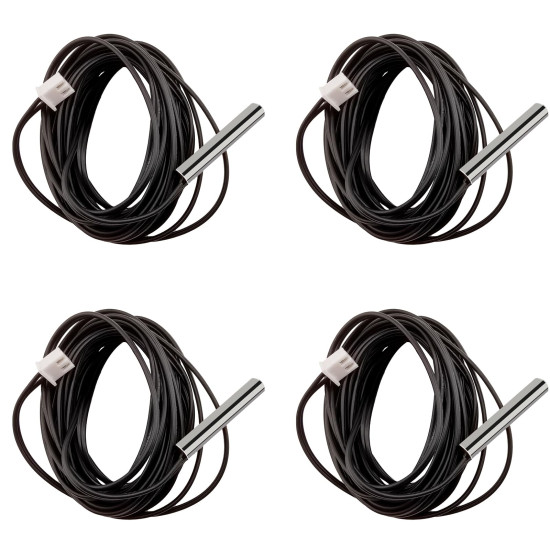
Accurate thermal acquisition in damp, condensing, or completely submerged environments poses unique engineering challenges for standard silicon temperature sensors. The Waterproof Stainless Steel 10K NTC Thermistor Probe provides a resilient, cost-effective, and highly precise thermal monitoring interface specifically packaged for harsh fluid and atmospheric conditions. At its core, the device incorporates an ultra-stable Negative Temperature Coefficient (NTC) ceramic semiconductor element exhibiting a nominal 25 degrees Celsius base resistance of 10 kilo-ohms with an exceptional one percent tolerance rating. As ambient or fluid thermal energy transfers across the metal encapsulation sheath, the internal ceramic matrix alters its electrical resistance in an inverse exponential relationship, yielding high thermal sensitivity and continuous analog resolution across typical working ranges.

Standard integrated circuit temperature sensors frequently suffer from package degradation, moisture ingress, or trace shorts when exposed to condensation, liquid immersion, or freeze-thaw cycles. This sensor circumvents vulnerability by encapsulating the primary NTC bead inside an industrial-grade, corrosion-resistant stainless steel cylindrical cap. The sensing assembly is internally bonded using high-thermal-conductivity waterproofing epoxy that seals the conductive elements entirely from the outside environment. The ruggedized build ensures dependable operational continuity throughout wet HVAC conduits, liquid reservoirs, and exposed outdoor meteorological monitoring stations without the risk of galvanic corrosion or dielectric breakdown between the sensor poles.

Physical Construction and Material Properties

The protective encapsulation cylinder is fabricated from grade 304 or 316 stainless steel, measuring 5 mm in diameter by 25 mm to 30 mm in length. This metallic geometry provides rapid heat conduction into the embedded thermistor core while maintaining outstanding structural rigidity against mechanical impact and hydraulic pressure. Thermally conductive potting compound fills all internal voids within the steel cylinder, eliminating microscopic air gaps that would otherwise introduce thermal lag or insulation barriers. The result is a dynamic thermal time constant of less than ten seconds in moving liquid conditions.

Extending from the base of the metal probe is a flexible, twin-lead cable jacketed in high-durability Polyvinyl Chloride (PVC). Rated for continuous operational duty up to 105 degrees Celsius, this dual-conductor harness resists environmental moisture, ultraviolet radiation, and mild chemical exposure. The overall lead length is approximately one meter, allowing designers to position the sensitive monitoring head deep inside vessels, tanks, or exterior ductwork while terminating the raw leads into control electronics or microcontrollers located in a dry, isolated junction enclosure.

Mathematical Foundations: Resistance Characteristics and Steinhart-Hart Conversion

The underlying behavior of an NTC thermistor is governed by ceramic semiconductor materials—typically sintered metal oxides of manganese, nickel, cobalt, and iron—whose valence electrons transition into conduction bands as thermal excitation increases. To accurately convert the analog resistance into absolute temperature values, systems can leverage either the simplified exponential Beta parameter equation or the extended Steinhart-Hart polynomial.

For common operational parameters, the standardized Beta model relies on the catalog B25/50 constant of 3950 Kelvin (+- 1%). The relationship between nominal resistance at 298.15 Kelvin (25 degrees Celsius) and resistance at a target temperature is expressed through the logarithmic equation: 1/T = 1/T0 + (1/Beta) * ln(R/R0), where temperatures are calculated in absolute Kelvin. For precision instrumentation covering the full -25 degrees Celsius to +105 degrees Celsius operating envelope, implementing the third-order Steinhart-Hart formulation (1/T = A + B*ln(R) + C*(ln(R))^3) provides sub-decimal accuracy, correcting for non-linear curve shifts across extreme cold and hot saturation thresholds.

Hardware Interfacing and Signal Conditioning

Interfacing this passive resistance sensor with microcontrollers such as Arduino, ESP32, STM32, or dedicated Analog-to-Digital Converters (ADCs) requires a standard voltage divider topology. Because the thermistor is a non-polarized two-terminal variable resistor, either lead can be connected to the reference excitation voltage or circuit ground without damage. Typically, a high-stability, low-temperature-coefficient 10 kilo-ohm precision pull-up resistor is paired with the thermistor across a 3.3V or 5.0V system bus. The midpoint node between the fixed reference resistor and the thermistor routes directly to an analog input pin.

To mitigate high-frequency electrical noise coupled along the one-meter cable run, engineers should place a small 100 nF ceramic bypass capacitor across the analog input terminal and circuit ground, creating a low-pass filter with an appropriate corner frequency. Furthermore, firmware developers must account for internal self-heating effects caused by continuous bias current passing through the semiconductor core. By keeping excitation currents low, using intermittent ADC sampling, or deploying transient voltage pulses to power the divider network only during conversion sequences, self-heating errors can be maintained well below 0.05 degrees Celsius.

Pinout and Electrical Connection Details

The sensor features a simple, robust two-wire flying-lead termination designed for direct soldering, screw-terminal clamping, or integration into industrial wire-to-board connectors.

Lead 1 (Signal / Voltage Divider Ingress): Stripped wire lead with tin-plated stranded core. Connects to one leg of the internal NTC thermistor element. In a standard pull-up divider configuration, this conductor terminates at the common junction between the precision 10K reference resistor and the analog measurement ADC pin. Since the sensing core is completely non-polarized, Lead 1 and Lead 2 are functionally interchangeable.

Lead 2 (Ground / Voltage Return Path): Stripped wire lead with tin-plated stranded core. Connects to the opposing leg of the internal NTC thermistor element. Typically tied directly to system analog ground (AGND) or reference negative plane. The non-polarized construction ensures complete protection against reverse polarity wiring errors, simplifying manufacturing and field assembly.

Eight Application Use-Cases

1. Hydronic HVAC and Chilled Water Line Monitoring

In residential and commercial central climate systems, monitoring supply and return fluid temperatures across radiant floor loops and chiller evaporators is essential for thermodynamic efficiency. Clamping or inserting the stainless steel sensor probe directly into liquid manifolds gives automation platforms accurate thermal feedback, enabling variable-frequency circulation pumps to dynamically scale flow rates and avoid sub-dewpoint condensation formation along primary conduits.

2. Aquaponics, Hydroponics, and Nutrient Reservoir Management

Plant root vitality and aquatic ecosystem balances depend fundamentally on stable water temperatures. Nutrient solutions that experience temperature spikes above 22 degrees Celsius lose dissolved oxygen carrying capacity and foster pathogen proliferation such as root rot. This waterproof probe can remain continuously submerged in reservoirs to supervise nutrient temperature profiles, automatically triggering inline chillers or immersion heating elements based on real-time ADC measurements.

3. Domestic Hot Water Heaters and Solar Thermal Collectors

Thermal stratification inside domestic storage tanks and solar evacuated tube loops requires distributed temperature telemetry. The probe metal head fits cleanly inside standard thermowells, delivering direct thermal conduction without exposing structural seals to pressurized hot water. The 105 degrees Celsius PVC rating offers ample overhead for standard hot water generation arrays operating below continuous boiling points.

4. Outdoor Weather Station and Frost Detection Nodes

Exterior environmental monitoring systems frequently encounter high humidity, heavy precipitation, and sub-zero frost conditions that degrade unprotected surface-mount transducers. Housed in a compact stainless envelope, this sensor resists prolonged freeze-thaw cycles and direct rain exposure. Remote telemetry microcontrollers can detect sub-zero ground or surface frost thresholds, initiating highway de-icing alerts or agricultural crop irrigation sprinklers to protect delicate fruit buds.

5. Refrigeration Evaporator Coil Defrost Cycling

Commercial freezers and heat pump external exchange units endure periodic ice accumulation across their evaporator fins. Placing the probe in thermal contact with the cooling coil matrix permits control logic to monitor temperature drop anomalies associated with frost buildup. When the coil falls below efficiency thresholds, the controller activates defrost heaters, turning them off the instant the sensor registers above-freezing thermal clearance to minimize energy usage.

6. Fermentation Vessels and Automated Homebrewing Systems

Yeast kinetics during beer, wine, or kombucha fermentation mandate strict temperature control profiles within a narrow two-degree band. The waterproof cylinder can be safely sanitized and placed within a fermenter thermal well or submerged fluid jacket. Real-time temperature acquisition allows proportional-integral-derivative (PID) algorithm controllers to activate cooling coils or heating belts, preserving targeted ester profiles and eliminating hot-fermentation off-flavors.

7. Submersible Fluid Monitoring in Industrial Machinery Coolant Loops

Computer Numerical Control (CNC) cutting tools, dielectric electric discharge machines, and heavy motor bearing reservoirs require uninterrupted cooling circulation. Integrating this 10K sensor directly into coolant tanks provides thermal trending logs that alert supervisory control and data acquisition (SCADA) networks when fluid heat capacity degrades, signaling clogged filters, depleted coolant levels, or impending pump failure.

8. Terrarium and Vivarium Environmental Control Architecture

Captive reptile habitats and tropical bio-active enclosures demand accurate tracking of warm basking zones and cooler substrate pockets where humidity levels routinely reach 100 percent. The durable outer sheath prevents animal chewing damage while remaining unaffected by overhead misting systems or saturated moist soil. Microcontrollers reading this sensor can regulate proportional radiant heat panels and substrate heating pads safely.

Official Resources & Manuals

Ginō Ginō AI - Nerokas AI Assistant
✕
Jambo! I am Ginō, a Nerokas AI Assistant and Africa's best Open Hardware Facilitator AI agent here to help. In order to serve you better and to help me give you accurate shipping estimates as we begin, could you please tell me your name and your location/city?

You can also ask about any hardware or type I'd like to order, I am looking for..., you can also LIST all SKUs & Quantity of desired items from our website here for me to help you Checkout automatically at anytime to fast-track your requests and orders.